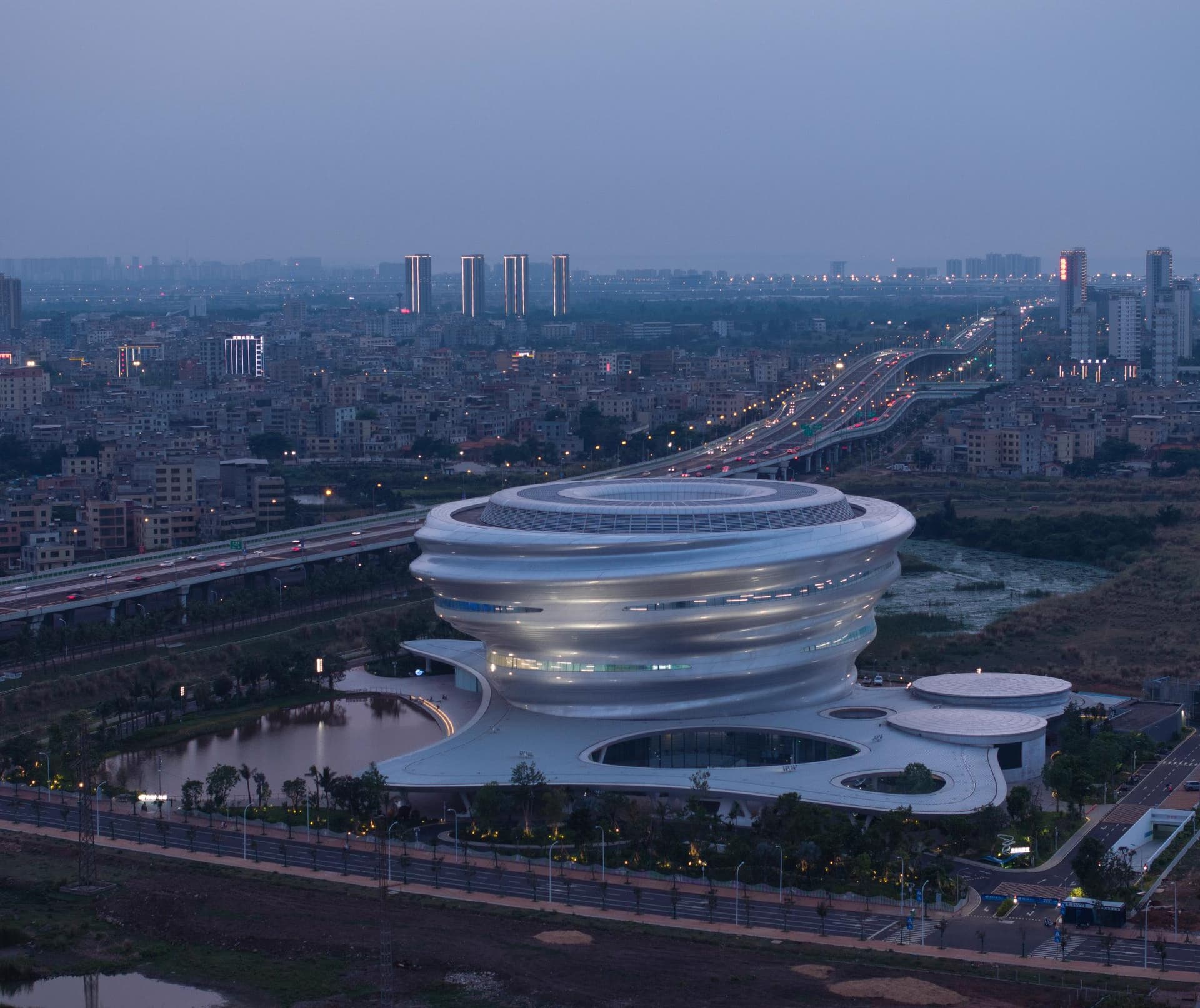
The Hainan Science Museum in Haikou, designed by MAD Architects under Ma Yansong, represents a significant example of contemporary large-scale cultural architecture in China, combining structural innovation with an integrated educational brief. Located adjacent to the Wuyuan River National Wetland Park, the building occupies approximately 46,500–46,528 square meters and functions as a regional science education hub for Hainan Province.
The project is defined by a continuous spiral geometry that organizes both form and program. Rather than relying on a conventional stacked typology, the museum consolidates its exhibition spaces, planetarium, large-format cinema, and ancillary educational functions into a single uninterrupted circulation system. This spatial strategy eliminates discrete floor-based zoning in favor of a continuous experiential sequence, where visitors traverse scientific themes through a gradual vertical progression.
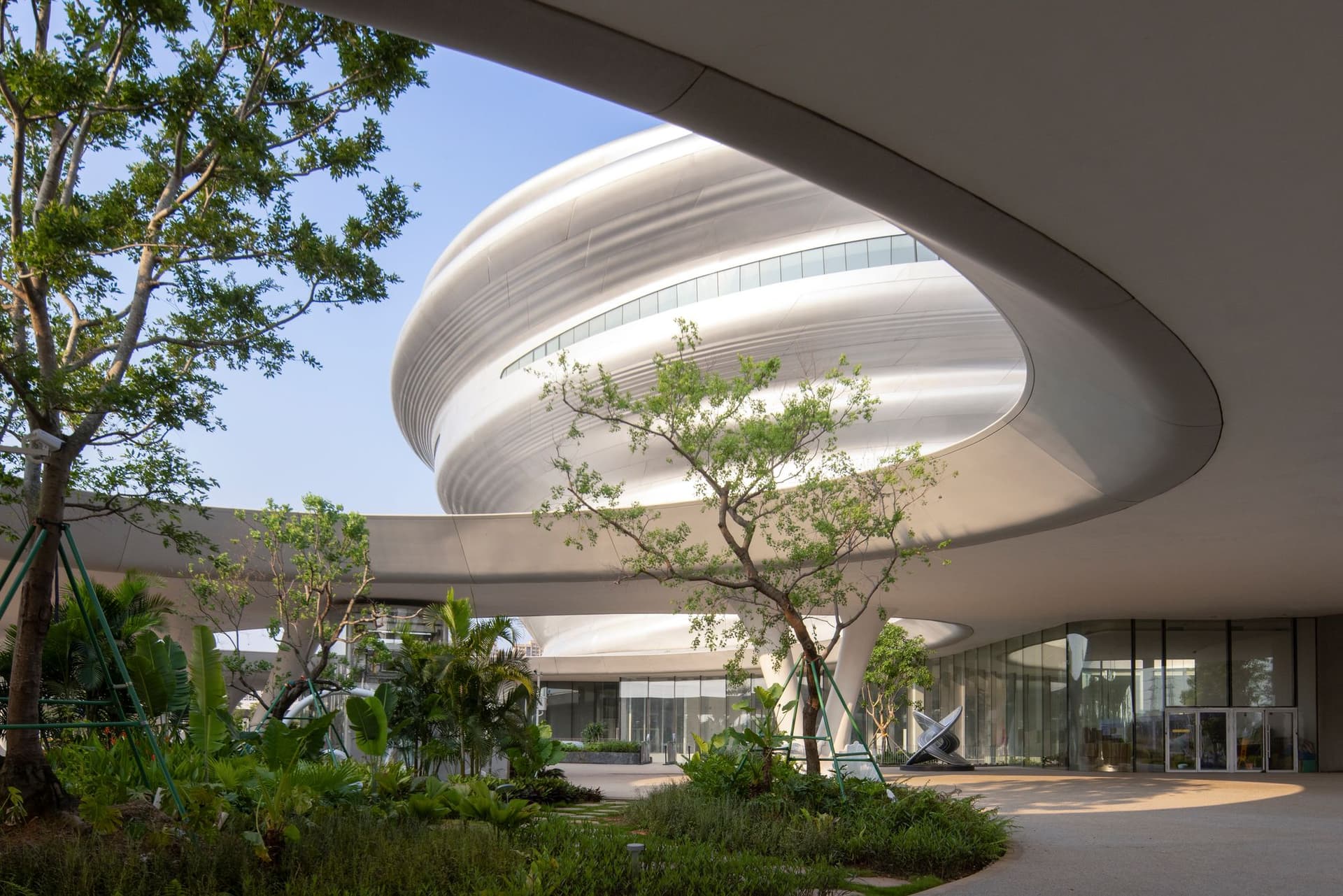
Structurally, the museum is distinguished by its column-free interior system. The spiraling exhibition floors are supported by three primary reinforced concrete core tubes, which accommodate both gravity loads and lateral stability requirements. This structural approach enables the creation of large, unobstructed gallery spaces while maintaining the integrity of the complex curved geometry. The separation of structural support from the exhibition envelope is central to the project’s spatial performance.
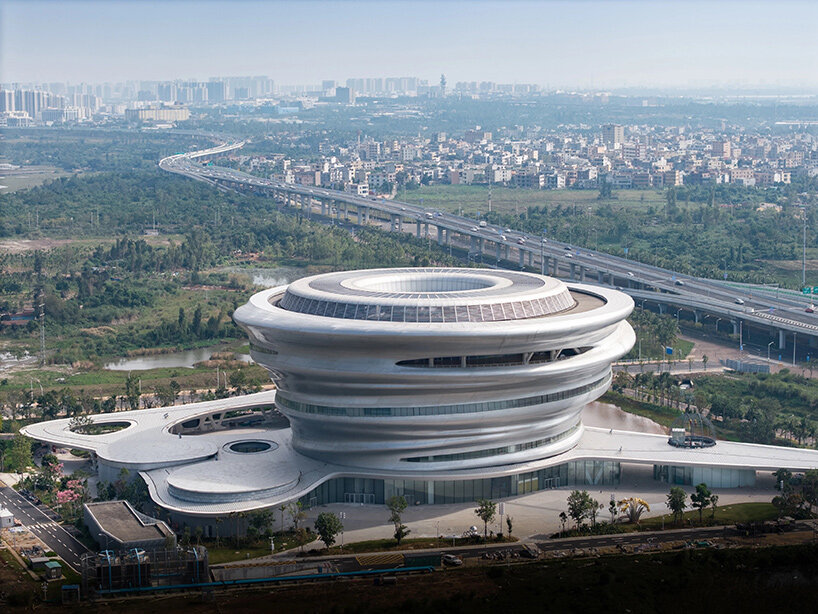
The building envelope is composed of approximately 843 fiber-reinforced polymer panels forming a continuous metallic cladding system. This skin operates both as environmental mediation and visual articulation, responding to Hainan’s high humidity, intense solar exposure, and coastal atmospheric conditions. The façade’s horizontal slot openings introduce controlled permeability, revealing interior circulation and reinforcing the stratified depth of the spiraling volume. 
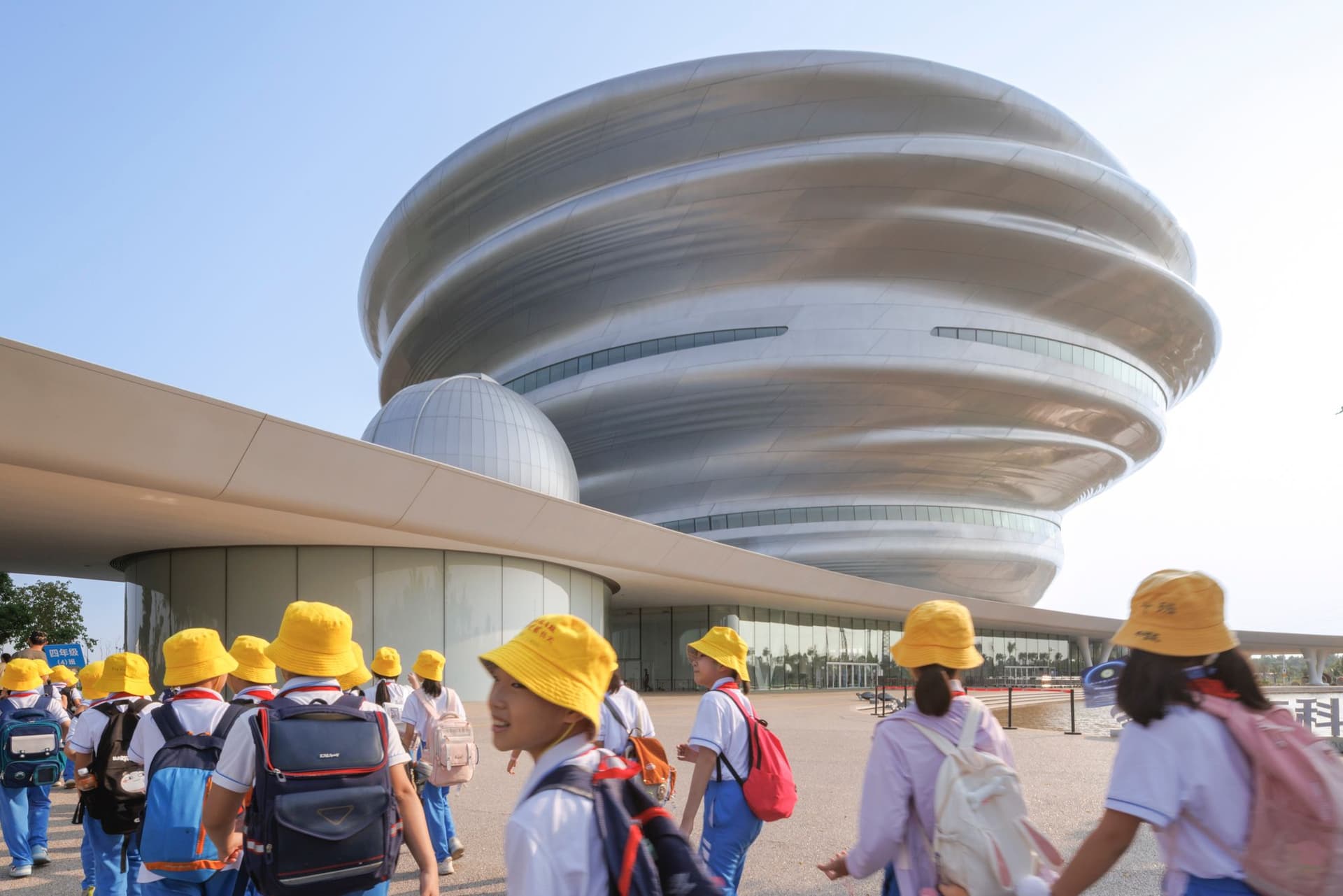
Programmatically, the museum extends beyond exhibition functions to include a planetarium, immersive screening facilities, a sunken public plaza, and outdoor landscaped zones. These components position the building as a hybrid civic infrastructure rather than a singular institutional object.
The site strategy reinforces this role. Situated within a dense educational district containing more than 30 schools and kindergartens, the museum is integrated into everyday urban pedagogy rather than isolated cultural consumption. Its adjacency to ecological landscape systems further anchors the project within a broader environmental framework.
Source: MAD Architects with additional information added by Glass Balkan