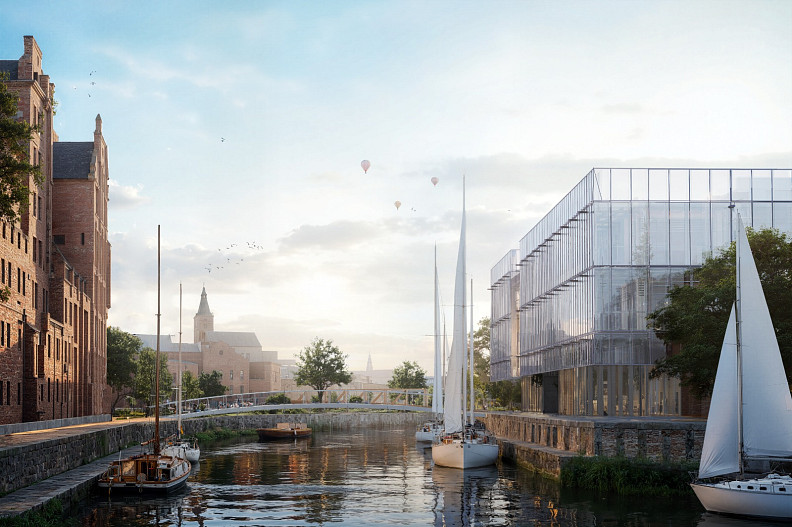
The Second-Level Music School proposed for Jaskółcza Island in Szczecin is defined by a performance-driven building envelope where glass and façade engineering play a central architectural and technical role. Located in an acoustically hostile post-industrial waterfront, the project treats the façade not as a neutral boundary but as an active system designed to manage sound, climate, structure, and public interaction.
The primary envelope concept is a double-skin façade, composed of an external steel frame and an inner thermally insulated glazed layer. The outer skin acts as a first acoustic barrier against railway and river noise, supporting laminated safety glass panels that form a continuous protective screen. The intermediate cavity functions as both an acoustic buffer and a climatic regulator, reducing external sound pressure while improving thermal stability. Ventilation within this zone is carefully positioned to avoid dominant noise directions, ensuring controlled air movement without compromising acoustic comfort.
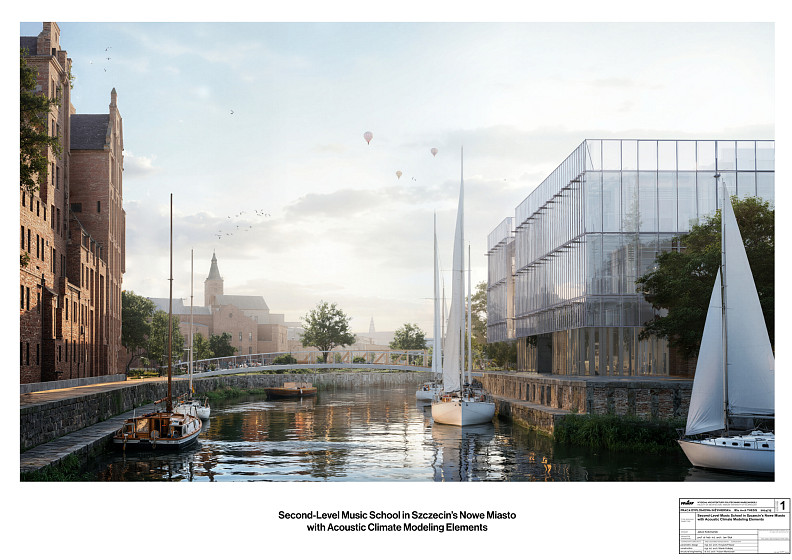
The inner façade consists of program-specific insulated glazing units, with glass thickness and laminate composition adjusted according to function. Concert hall-adjacent zones and practice areas employ heavier, asymmetrical laminated glazing to enhance airborne sound insulation, while foyers, circulation spaces, and exhibition areas use lighter high-performance IGUs to maximize daylight and visual transparency. This differentiation allows precise acoustic control without unnecessary material intensity.
Transparency across the façade is deliberately modulated. Public functions such as the main foyer, café, and viewing terraces are expressed through larger glazed surfaces, reinforcing the building’s cultural presence along the waterfront. Educational and rehearsal spaces remain visually connected yet acoustically protected through recessed glazing and shielding by the external skin. 
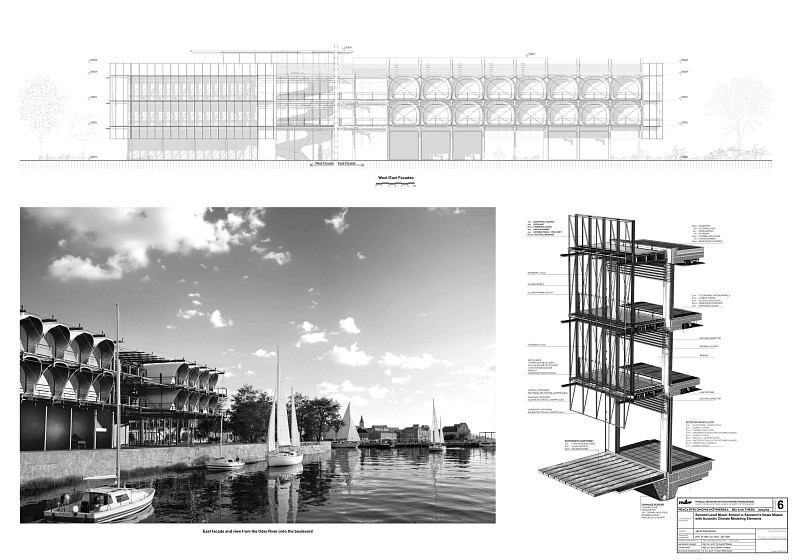
Internally, prefabricated acoustic tube practice rooms are structurally decoupled from the façade and main frame, minimizing vibration transfer. Glass partitions within these zones maintain visual supervision while preserving acoustic isolation. Integrated with a reinforced-concrete structural system and green roof strategy, the façade operates as a calibrated architectural instrument, transforming analytical data into a resilient, acoustically controlled, and publicly engaging glass envelope.
Source: inspireli.com with additional information added by Glass Balkan