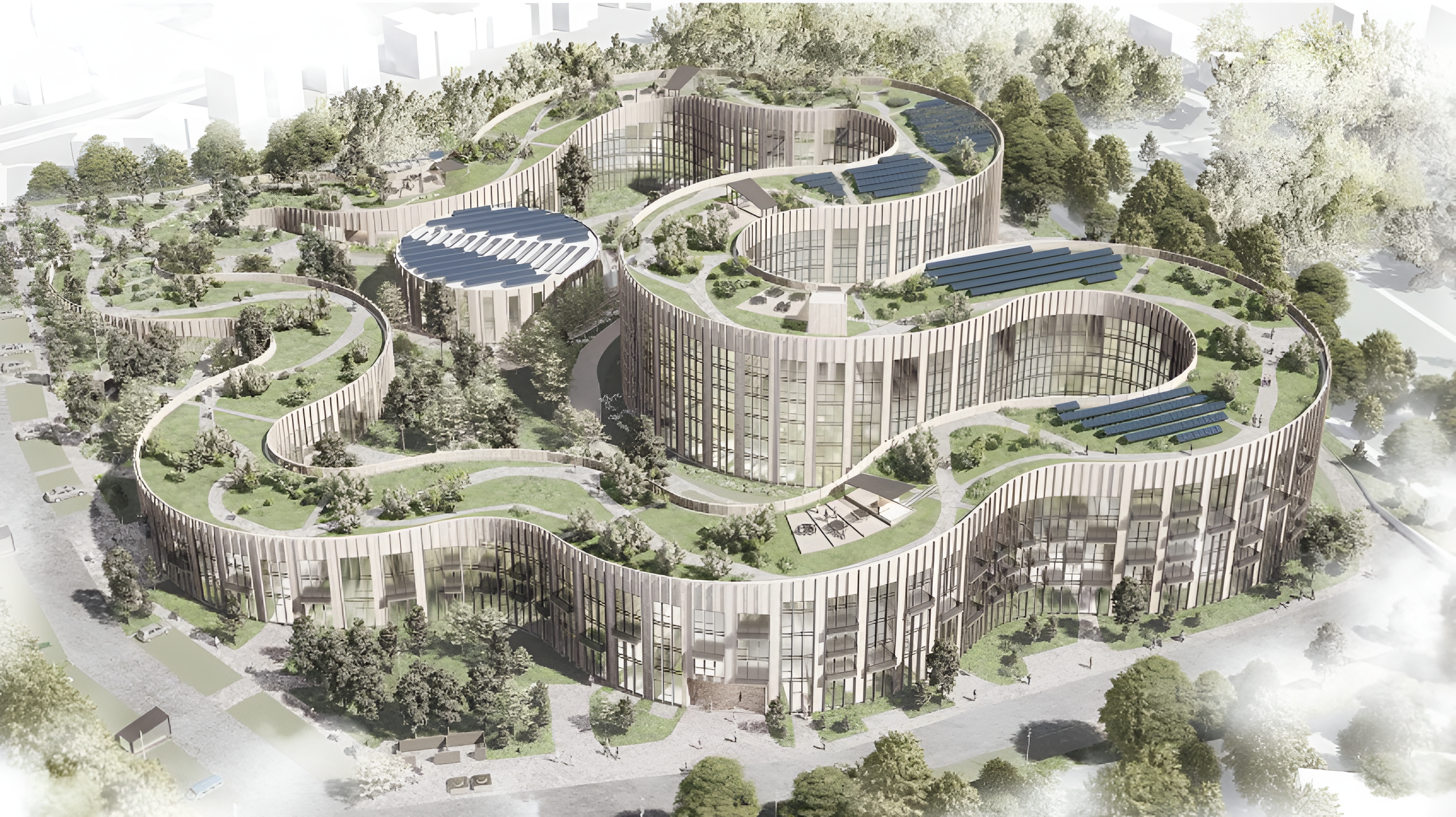
Basecamp Lyngby, designed by Lars Gitz Architects, represents a significant development in contemporary European student and intergenerational housing, where architectural form, environmental performance, and social programming are conceived as a unified system rather than separate design layers. Located approximately 10 km north of Copenhagen, the project occupies a 34,300 m² site and establishes a high-density residential framework integrating over 600 student units, approximately 50 senior apartments, and additional guest accommodation.
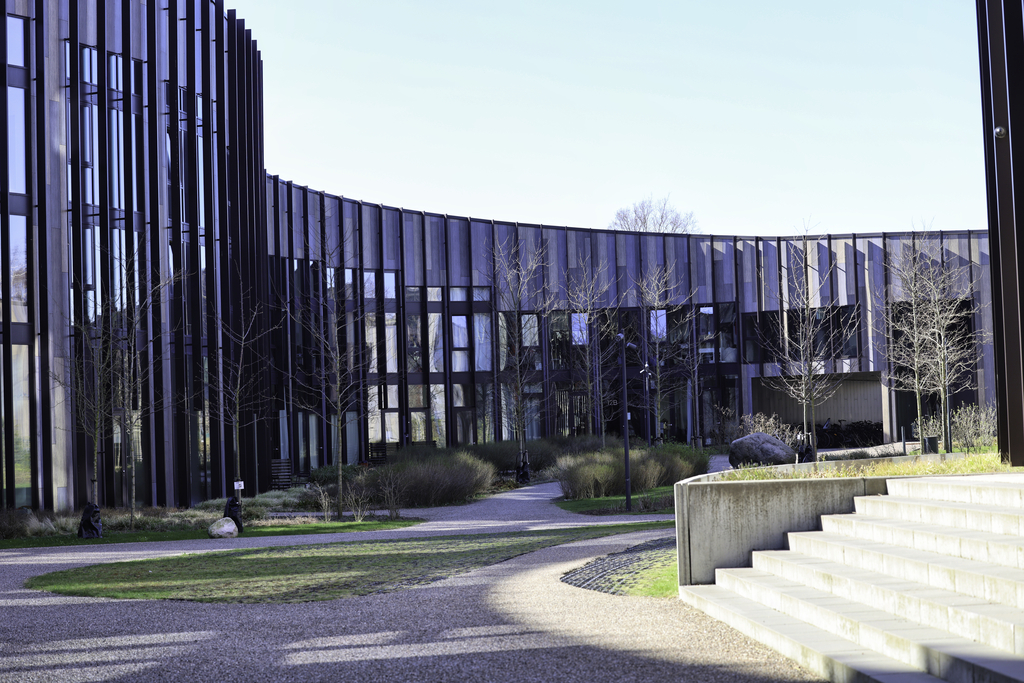
The project’s defining spatial logic is derived from a repetitive trapezoidal module rotated along a continuous curved axis. This generates a serpentine massing strategy that organizes the building as a continuous infrastructural loop rather than discrete blocks. The resulting geometry enables a calibrated distribution of built volume around preserved site vegetation, producing a sequence of semi-enclosed courtyards that function as intermediate social and environmental buffers. These voids are not residual spaces but intentionally programmed micro-environments supporting informal interaction, visual permeability, and daylight penetration.
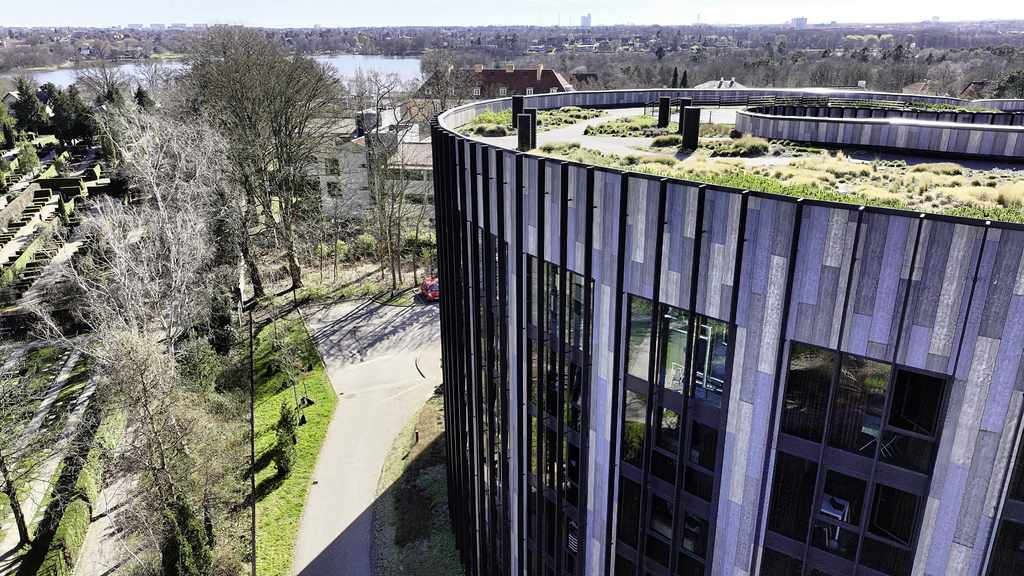
A critical architectural decision is the elevation of the building into a continuous landscape roof, extending the ground plane into a six-storey elevated topography. This green roof system operates as both ecological infrastructure and spatial extension, incorporating grass and flowering vegetation while supporting a continuous circulation path. It functions as a public-like linear park, offering panoramic visual access toward Lake Lyngby and reinforcing the project’s conceptual positioning of architecture as inhabitable landscape rather than object-based construction.
Environmental performance is embedded in both envelope and systems design. The façade incorporates approximately 4,000 insulated glazing units utilizing Pilkington Suncool 70/40 supplied by Glaseksperten A/S. This specification achieves a controlled solar gain strategy, balancing high daylight transmittance with reduced thermal load, thereby mitigating cooling demand while maintaining visual continuity with the surrounding landscape. In parallel, energy recovery ventilation systems are implemented, enabling up to 90% heat recovery from exhaust air, while floor slab thermal mass contributes to diurnal load stabilization. 
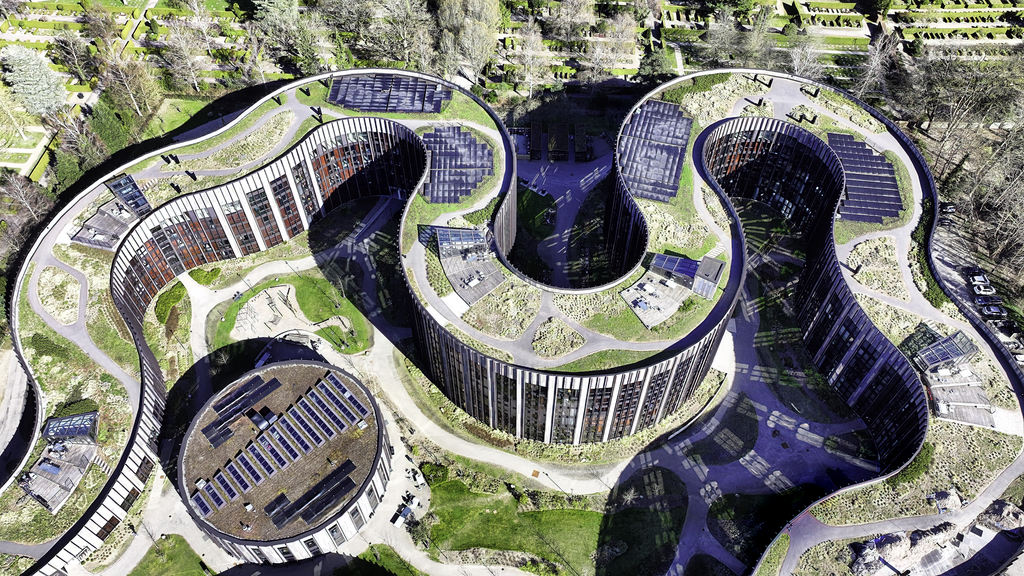
The project operates under a DGNB Gold certification framework, reflecting integrated sustainability criteria across environmental, economic, and social dimensions. Key strategies include stormwater retention via the extensive green roof system, reduction of urban heat island effects, and enhancement of local biodiversity through layered planting strategies. The façade and building envelope are calibrated to optimize daylight autonomy while minimizing operational energy consumption.
Programmatically, the development is structured around a dual hierarchy: private residential units and a dense network of shared infrastructure. Interior planning, developed by Studio Aisslinger, prioritizes compact private living conditions supplemented by extensive communal programming, including shared kitchens, laundries, fitness areas, and study environments. A central communal volume functions as the social condensate of the scheme, explicitly designed to facilitate cross-cohort interaction between students and senior residents, reinforcing the project’s intergenerational housing model.
The architectural and urban strategy positions Basecamp Lyngby within a broader discourse on socially sustainable housing typologies, particularly the reconfiguration of student accommodation as a hybridized civic infrastructure. The project has received multiple international recognitions, including the Golden A’ Design Award in Architecture (2020), the Iconic Award for Architecture (2020), and the Green Cities Europe Award (2023), reflecting its relevance as a reference case for integrated design approaches combining modular construction logic, landscape urbanism, and high-performance building envelopes.
Source: Pilkington with additional information added by Glass Balkan