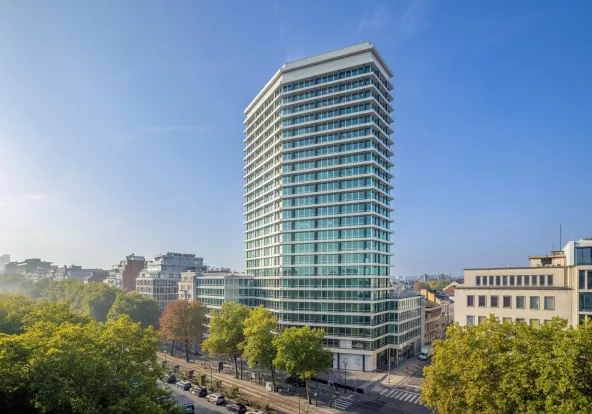
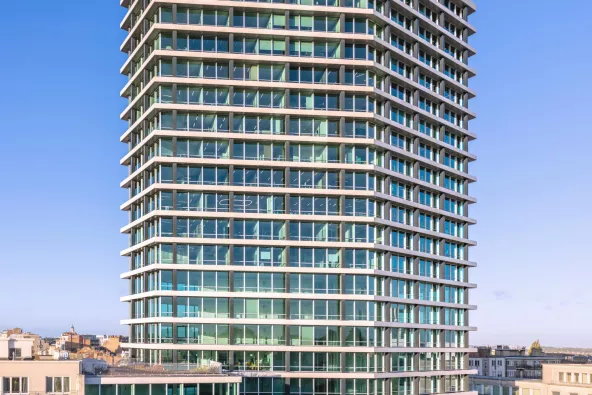
The Louise Tower has long been one of the most recognisable elements of the Brussels skyline. Formerly known as the ITT and Generali Tower, the building has recently undergone a major renovation that demonstrates how advanced façade engineering and high-performance glass can reposition an ageing structure for contemporary demands without compromising its architectural identity.
Located in the heart of the Belgian capital, the project represents a clear shift toward renovation-driven transformation rather than demolition. The intervention focused primarily on the building envelope, where glass became the defining tool in improving both aesthetics and technical performance. More than 7,000 m² of insulating glass were installed, creating a new visual clarity while significantly upgrading thermal, acoustic and energy behaviour.
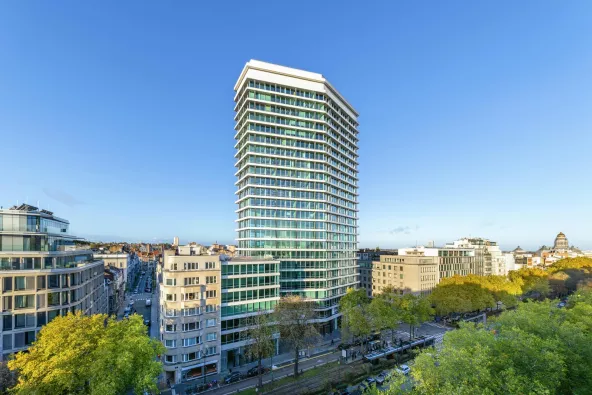
The project was designed by A2RC, with construction works carried out by CIT Blaton. The scope centred on facades and curtain walls, reflecting the growing role of façade renewal in extending the life cycle of urban office towers.
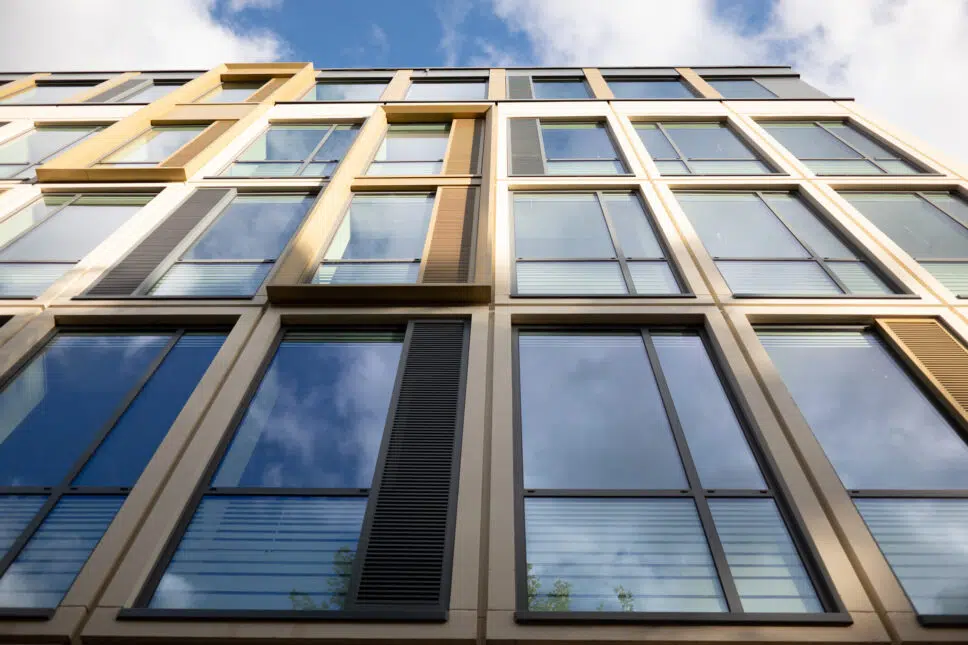
The original curtain wall no longer met today’s expectations for insulation or airtightness. A new façade concept introduced a high-performance system based on Stopray Solar Control glass combined with Stratophone Clearvision acoustic glazing. This combination allows the façade to simultaneously manage solar gains, improve indoor comfort and maintain strong visual transparency, a balance increasingly requested in modern office retrofits. 
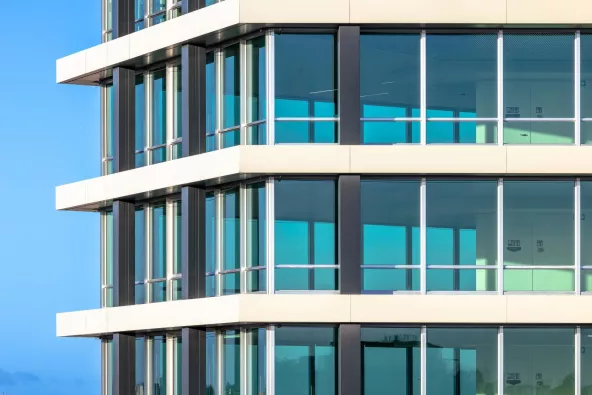
Stopray’s triple-silver solar control coating reduces overheating while preserving daylight, helping decrease cooling loads and stabilise internal temperatures. On the interior layer, Stratophone Clearvision integrates an acoustic PVB interlayer designed to reduce external noise transmission, an essential feature for dense city environments where occupant comfort directly influences workspace quality. The extra-clear composition also ensures a neutral appearance, preserving façade elegance even in thicker glass configurations.
The installation of the new glazing, integrated into aluminium profiles with thermal breaks, transforms the curtain wall into an active performance component rather than a passive exterior skin. Energy demand has been reduced while user comfort has been noticeably increased, reinforcing the role of glass as a multifunctional building material.
Beyond the façade, the renovation included upgraded technical systems such as heat recovery, LED lighting, intelligent climate control, rooftop photovoltaic panels and rainwater harvesting. These measures support long-term operational efficiency while aligning with Brussels’ sustainability objectives. All glass products used are Cradle to Cradle Certified® Bronze, reflecting a broader industry shift toward circular material selection.
Inside the tower, flexible office layouts and raised access floors allow future adaptability, ensuring that the building can evolve alongside changing workspace requirements. The result is a renewed landmark, one that bridges architectural heritage with forward-looking performance through the strategic use of advanced glass technologies.
Source: AGC with additional information added by Glass Balkan