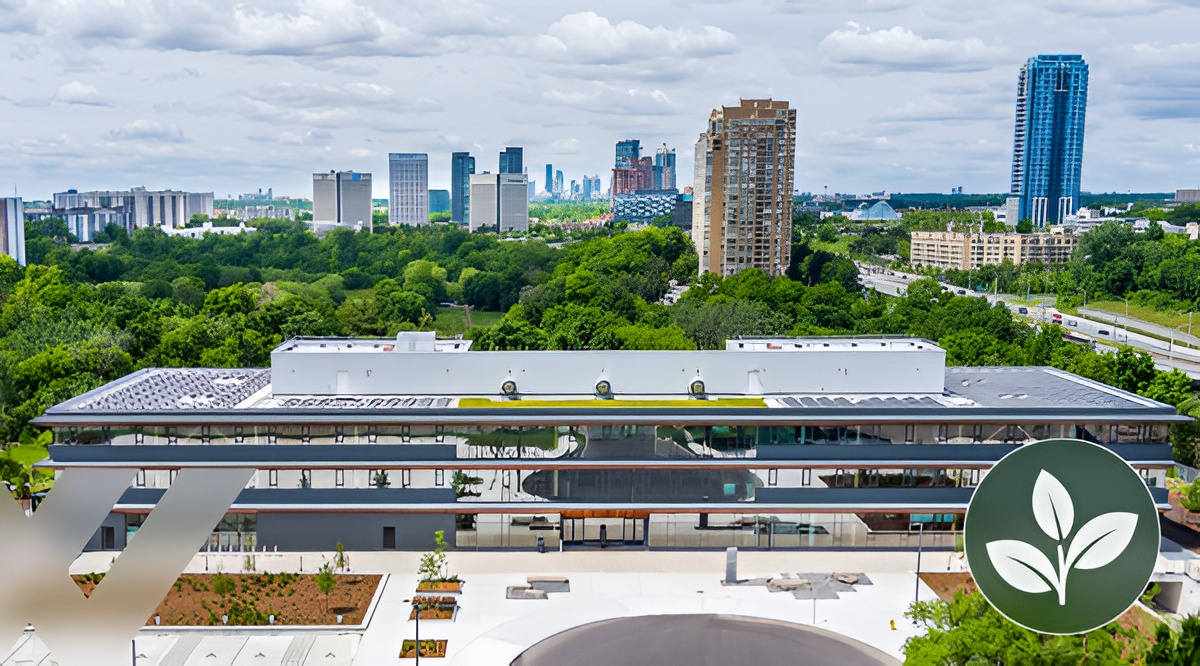
The OSSTF/FEESO Headquarters in Toronto, designed by Moriyama Teshima Architects, is a 127,000-square-foot mixed-use office building developed as a demonstrator for low-carbon institutional construction and next-generation façade performance. The project is targeting LEED® Platinum certification and Toronto Green Standard Tier 4, with a design strategy centered on embodied carbon reduction, operational efficiency, and occupant health.
Structurally, the building uses mass timber as a primary carbon-saving material, reducing embodied emissions compared to conventional steel-and-concrete systems while enabling faster prefabrication and improved interior warmth. This structural choice is paired with a high-performance curtain wall system that was engineered to maximize daylight while controlling solar heat gain and glare.
A key technical innovation is the glazing assembly combining AviProtek® E bird-friendly glass with Vitro Architectural Glass Solarban® 90 low-e coating. The configuration places the bird-safe frit pattern (AviProtek® E Pattern 215) on surface 1, while the low-emissivity coating is applied to surface 2. This separation allows optical clarity and bird-collision mitigation on the exterior while optimizing thermal insulation internally.
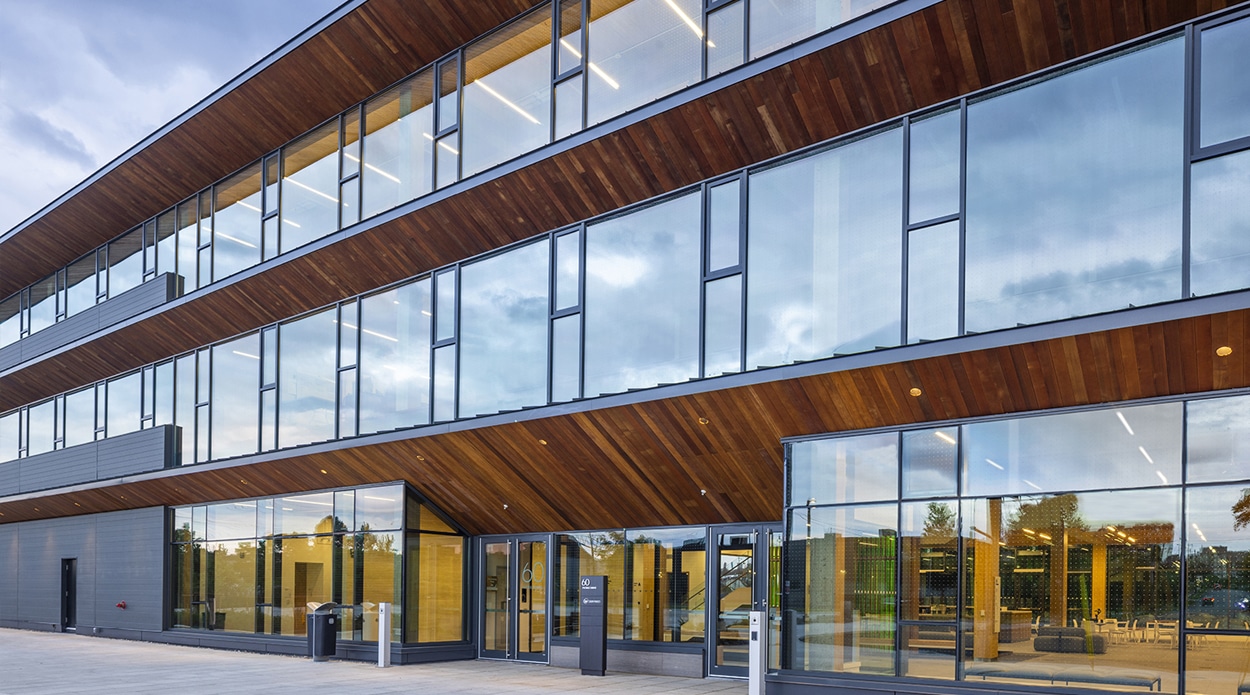
The system achieves a Solar Heat Gain Coefficient (SHGC) of 0.23, limiting unwanted solar heat gain, and a Visible Light Transmittance (VLT) of 51%, ensuring strong daylight penetration. Fabrication was completed by Trulite with installation by Gage Aluminum, ensuring tight tolerances for a high-performance envelope. 
The design team increased the window-to-wall ratio to approximately 60:40, supported by careful window head elevation adjustments to deepen daylight distribution. Interior lighting systems are fully integrated with daylight sensors, enabling daylight harvesting that reduces artificial lighting demand by around 60%. This directly lowers operational energy loads, particularly in lighting-dominant office zones.
The building also incorporates extensive biophilic design principles. Large glazed openings overlook adjacent ravine landscapes, enhancing visual connectivity to nature. This supports occupant wellbeing through circadian rhythm alignment, reduced visual fatigue, and improved cognitive performance.
AviProtek® E Pattern 215 was selected for its tested bird-collision deterrence performance while maintaining near-invisible visual disruption. The ceramic frit pattern is designed to be effective for avian species without compromising architectural transparency or daylight quality.
Source: Walker Glass with additional information added by Glass Balkan