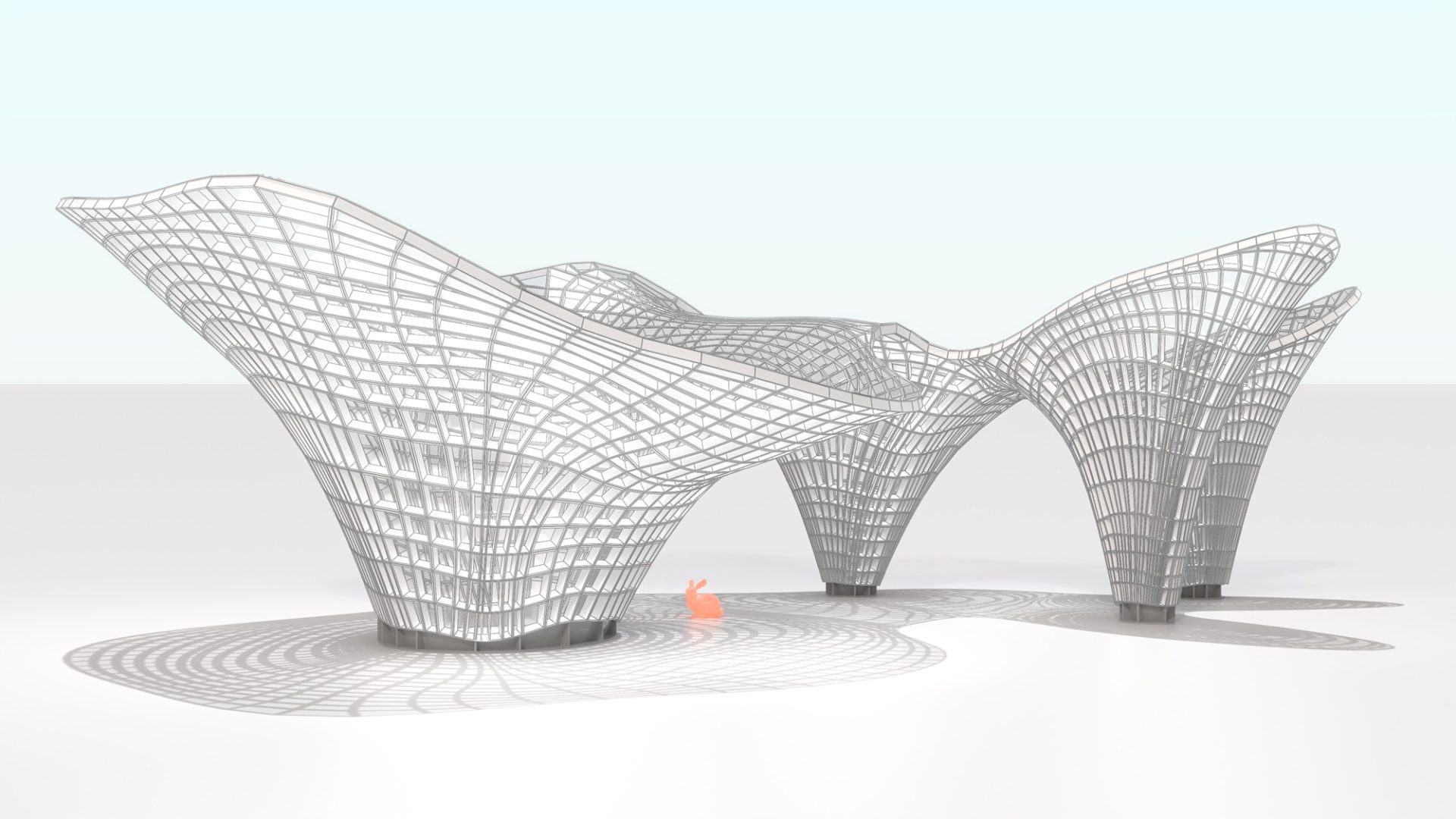
Thornton Tomasetti, in collaboration with the University of Tokyo, has introduced a new computational form-finding method that significantly advances the design of glass and metal gridshells spanning large, column-free spaces. Published in ACM Journals, the research addresses one of the industry’s biggest challenges: the high computational cost of designing complex, non-uniform shell geometries.
The method is built around Non-Uniform Rational B-Splines (NURBS), the same surface-definition system widely used in architectural CAD tools. Instead of converting geometry into heavy mesh-based models, the researchers perform structural analysis directly on NURBS surfaces. This shift reduces simulation times from around 90 hours on high-end GPUs to roughly 90 minutes on a standard CPU, an efficiency gain of up to 98 percent.
Led by Masaaki Miki (University of Tokyo) and Toby Mitchell (Thornton Tomasetti), the work targets modern gridshells made from metal and glass rather than traditional reinforced concrete. These systems must handle combined compression and tension forces, complex boundary shapes, fabrication constraints, and on-site assembly tolerances. The new algorithm identifies structurally optimal shell forms that remain stable under gravity while accommodating irregular edges and highly expressive geometries.
To support real-world use, the team developed a dedicated plug-in for Rhinoceros (Rhino), allowing architects and engineers to integrate the tool directly into existing design workflows. The result is a practical, accessible way to design lightweight, transparent gridshells that balance aesthetics, structural performance and constructability. 
Source: USGlassMag with additional information added by Glass Balkan