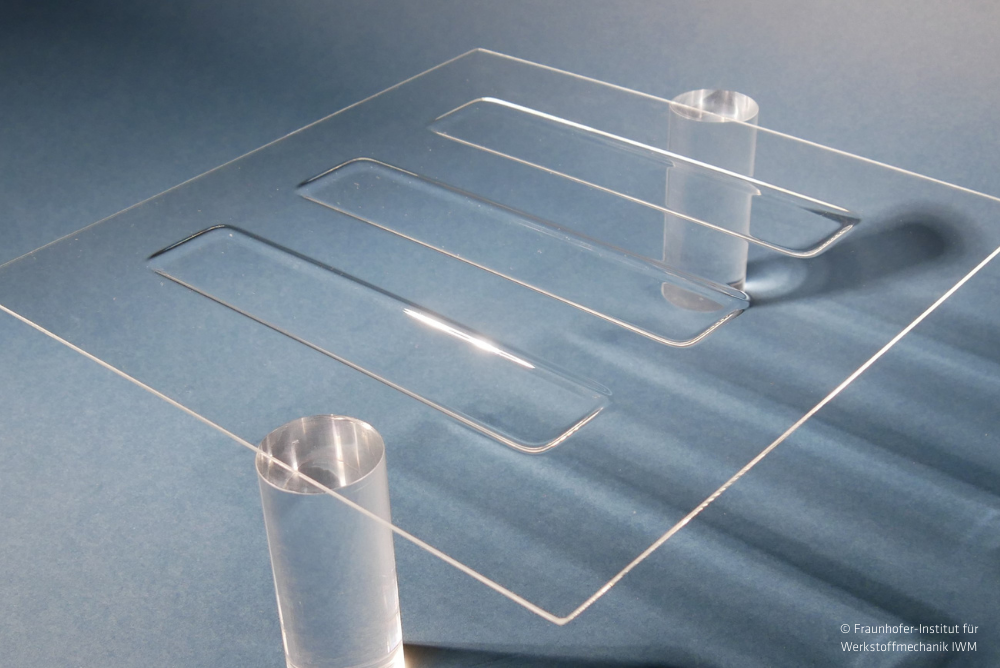
A new laser-assisted forming process developed at Fraunhofer IWM is redefining what flat glass can do, bringing precise, localised shaping, free-form structures, and improved load-bearing performance into one scalable manufacturing approach. Explained by Tobias Rist, researcher at Fraunhofer IWM and speaker at glasstec 2024, the technology enables glass to be bent or “gravity sunk” selectively, while keeping the surrounding areas stable and structurally flat.
Localised shaping without compromising flat-glass performance
The principle is simple, but powerful: glass is first heated inside a furnace, and then a laser introduces additional heat only where shaping is required. This targeted energy input allows highly controlled deformation, achieving bending radii as tight as ~1.5× the glass thickness. The key advantage is that the remaining glass stays cool enough to retain the original properties of flat glass, while reducing thermal stress risks that would normally cause cracking.
Two shaping modes: bending and gravity sinking
Fraunhofer IWM distinguishes between two forming strategies. The first is classic bending, where a pane is redirected along a defined line and the thickness remains nearly unchanged. The second is gravity sinking, where only a sub-area sinks into shape under its own weight, creating a transition zone that becomes thinner and allows more sculptural depth, often reaching 2–3× the glass thickness. Because the surrounding outer surface holds the geometry in place, the interior can be formed more freely, enabling highly design-driven results.
Structural stiffening through engineered geometry
Beyond aesthetics, the real impact is structural. By introducing ridges, folds, and localised 3D forms into the pane, the process increases the area moment of inertia, which directly boosts bending stiffness and load resistance. Rist compares this effect to corrugated metal sheets or roof reinforcements, lightweight geometry delivering high rigidity. This structural gain can allow the use of thinner glass with equal or better performance, supporting lower material consumption and reduced production energy. 
Practical opportunities: corners, transparency, sustainability
One of the most promising applications is all-glass corner glazing, especially for residential façades. Unlike conventional corner solutions, laser-shaped glass could deliver seamless transparency while reducing thermal bridges that typically trigger condensation and mould. With design freedom, improved statics, and the ability to optimise material use, Fraunhofer IWM’s laser shaping points toward a new chapter of high-performance, resource-efficient glass architecture.
Source: glasstec with additional information added by Glass Balkan