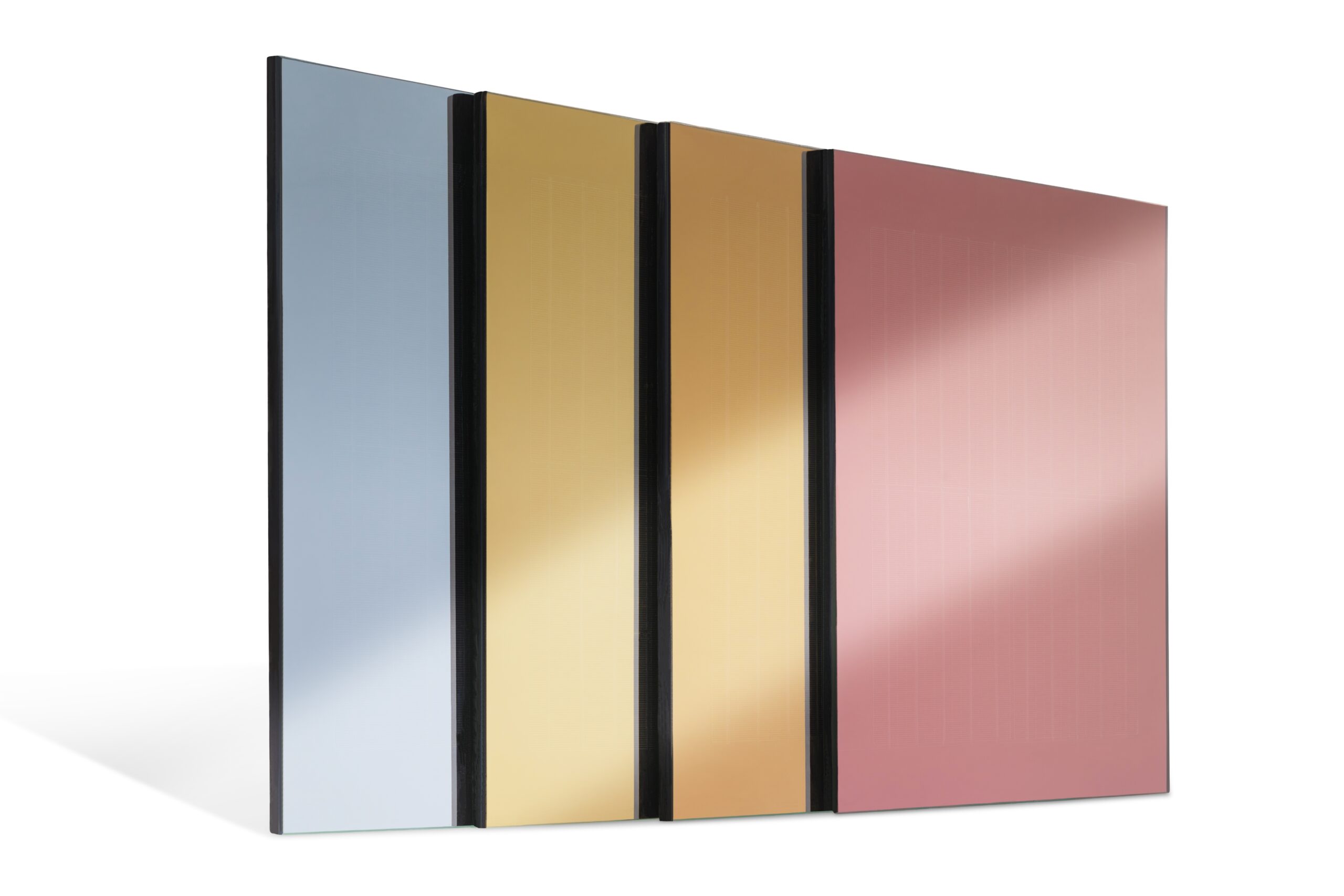
AGC Interpane Architectural Glass has introduced “ipasolar”, a new generation of coloured magnetron coatings designed for photovoltaic cover glass, bringing enhanced architectural flexibility to building-integrated photovoltaics (BIPV) without compromising performance.
The new coatings achieve efficiency levels of 90 to 96 percent, depending on the selected reflective colour, compared to an uncoated black module. This development addresses a key challenge in BIPV integration: enabling customised façade design while maintaining high energy yield.
The ipasolar range is initially available in standard colours including terracotta, green, blue, yellow, orange, red, bronze, gold, silver and pearl mouse grey. Custom colour options are also possible upon request, offering architects and module manufacturers expanded creative freedom. The coatings can be applied to large-format white glass substrates, depending on module specifications.
According to Steffen Kittler, Sales Manager at AGC Interpane Architectural Glass, ipasolar provides a solution that allows greater flexibility in colour design, helping integrate photovoltaic systems more seamlessly into modern façade concepts. The red version, for example, achieves up to 95 percent efficiency compared to a conventional black module, demonstrating that vibrant façade aesthetics can coexist with strong photovoltaic output. 
The technology is based on an original patent developed by the Fraunhofer Institute for Solar Energy Systems (Fraunhofer ISE). It combines rough white glass substrates for uniform light scattering with MorphoColor magnetron coatings, reducing angle dependency and supporting consistent colour homogeneity even on large surfaces.
Upscaling for initial large BIPV projects was carried out in collaboration with AGC Plasma and photovoltaic module manufacturer Axsun, supported under Germany’s “PVHide” project between 2019 and 2022.
Source: AGC Interpane with additional information added by Glass Balkan