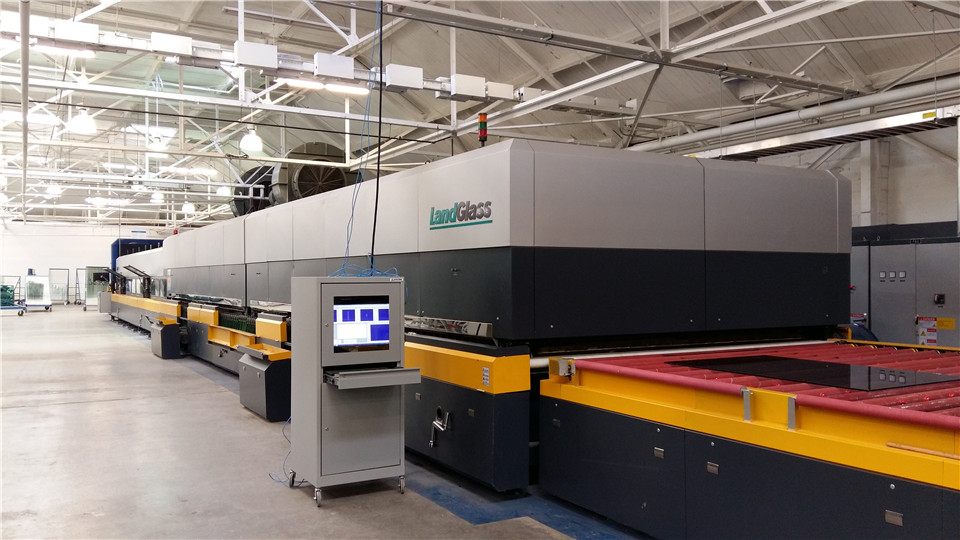
LandGlass has released practical guidance aimed at helping operators maximise the performance of glass tempering furnaces, focusing on the parameters that most directly influence flatness, anisotropy control, and optical quality in tempered safety glass production. The approach reinforces one key principle: premium results are not created inside the furnace alone, they are built through discipline before loading, accuracy during production, and consistency in continuous optimisation.
LandGlass stresses that stable quality starts with raw glass conditioning and strict surface preparation. Glass sheets should remain in the workshop for a minimum of 24 hours to achieve thermal equilibration, preventing uneven heating caused by temperature differences and minimising internal stresses introduced during transport. Before loading, glass must be fully cleaned and dried, removing dust, oil, and moisture that can become permanent surface marks or disrupt thermal uniformity.
A mandatory inspection step is also recommended to identify stones, inclusions, surface defects, and poor edge grinding, as these issues can be amplified during tempering and may impact both strength performance and final visual appearance.
On the equipment side, LandGlass highlights the importance of keeping the furnace chamber and heating elements clean, while ensuring ceramic rollers rotate synchronously and smoothly. Any debris, scaling, or roller surface contamination must be removed using specialised cleaning methods to avoid imprinting and roller-wave distortion. Quench airflow must also remain stable: nozzles should be cleared with compressed air, upper and lower chillers aligned and parallel, and fan impellers, couplings, and bearings routinely checked to maintain consistent air pressure. 
A strict First-Piece Inspection is advised at every shift start and for every change in thickness or glass type. Operators should measure flatness on a detection table using straight-edges and feeler gauges, while polarising filters help assess stress patterns and iridescence. To drive repeatability, LandGlass recommends logging every batch with key settings including temperature, heating duration, quench pressure, fen height, and oscillation, supported by a stable workshop environment free from cross-drafts that disturb hot glass or quench airflow.
Source: LandGlass with additional information added by Glass Balkan