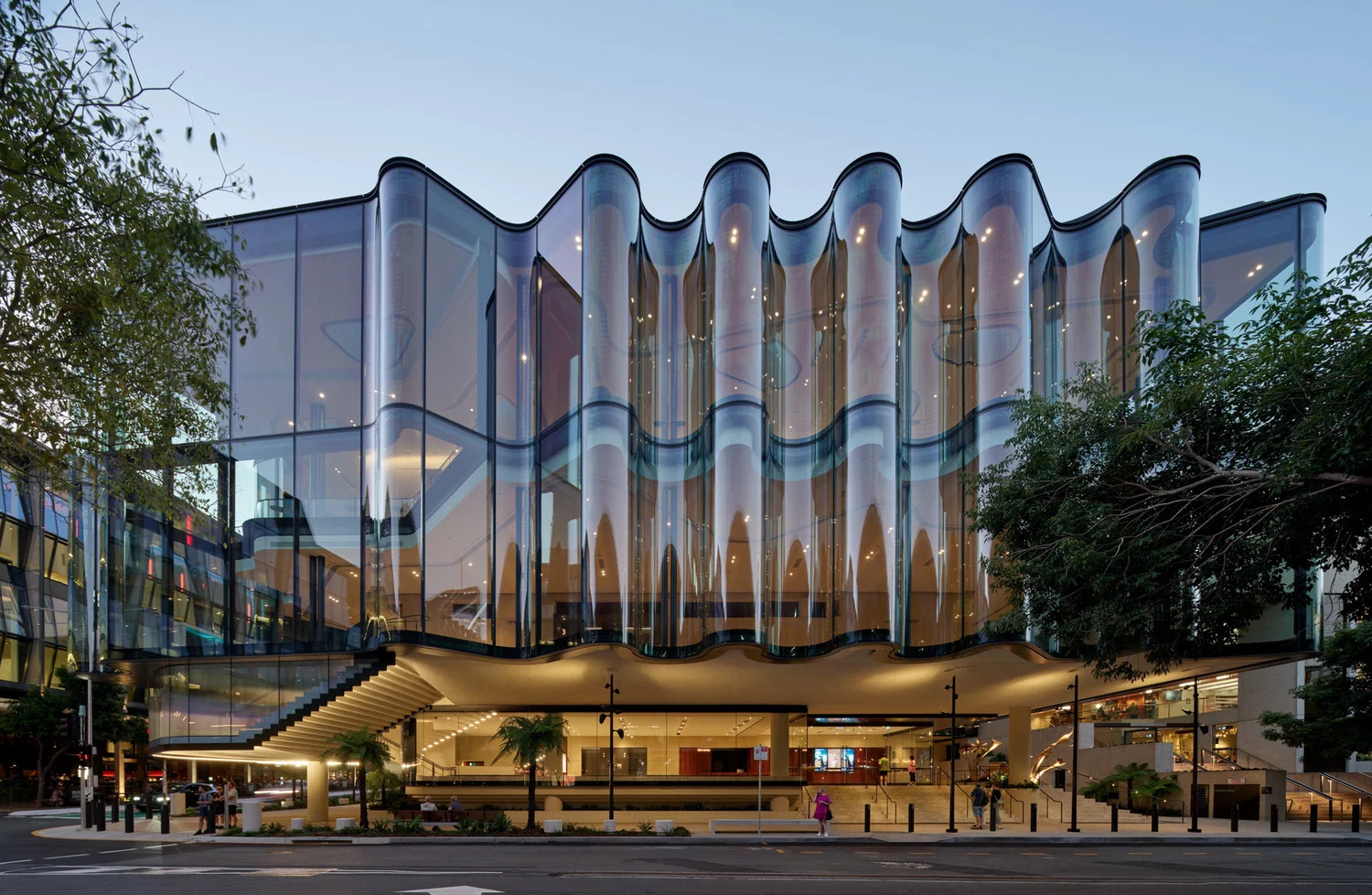
The Glasshouse Theatre at Queensland Performing Arts Centre has already been recognised as one of Australia’s most technically ambitious cultural developments. In GlassBalkan’s previous feature, the project by Blight Rayner Architecture and Snøhetta was highlighted for its integration of cultural storytelling, advanced theatre planning, and a striking rippling glass façade inspired by the Brisbane River.
Newly released technical details now reveal the extraordinary façade engineering and manufacturing processes behind the building’s iconic appearance, positioning the project as a benchmark for next-generation curved architectural glass.
The theatre’s undulating envelope was inspired by a prose-poem by Aboriginal Elder and artist Lilla Watson, referencing fish moving beneath the surface of the Brisbane River. Rather than applying symbolism superficially, the architects translated this movement directly into the geometry of the façade itself. According to Michael Rayner, Director of Blight Rayner Architecture, the intent was to create a transparent “public theatre” where activity inside the foyer would become visually layered and animated from the surrounding streetscape.
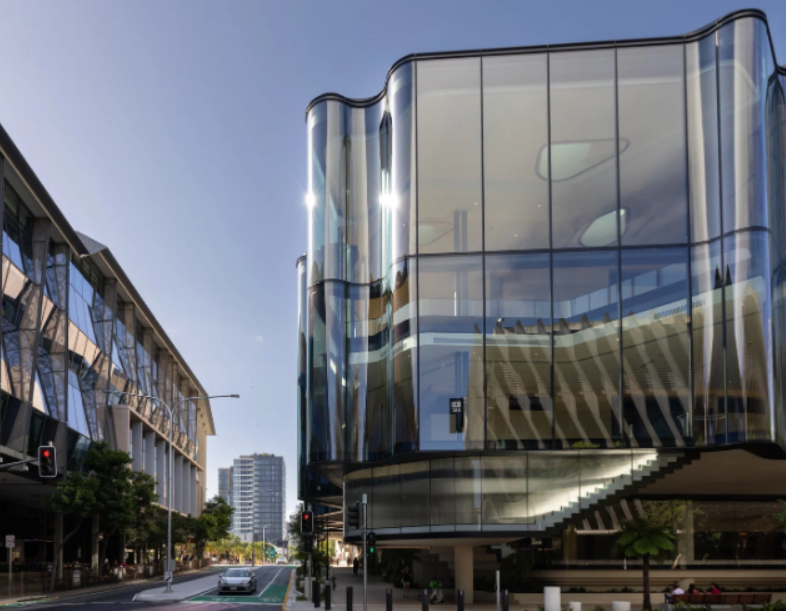
Delivering this effect required one of the most complex curved glazing applications seen in a contemporary performing arts project. The façade incorporates large-format, double-curved insulated laminated tempered glass manufactured by NorthGlass. Individual panels reach approximately 7 metres in height and achieve a minimum bending radius of just 1 metre, an extremely tight curvature for insulated laminated units of this scale. 
What makes the system particularly challenging is the continuous transition between concave and convex geometries across the façade surface. Unlike standard cylindrical bending, these panels required highly controlled free-form curvature to maintain the fluid “water ripple” effect envisioned by the architects. Any inconsistency in curvature alignment, roller-wave distortion, or reflected image quality would become immediately visible across the transparent envelope.
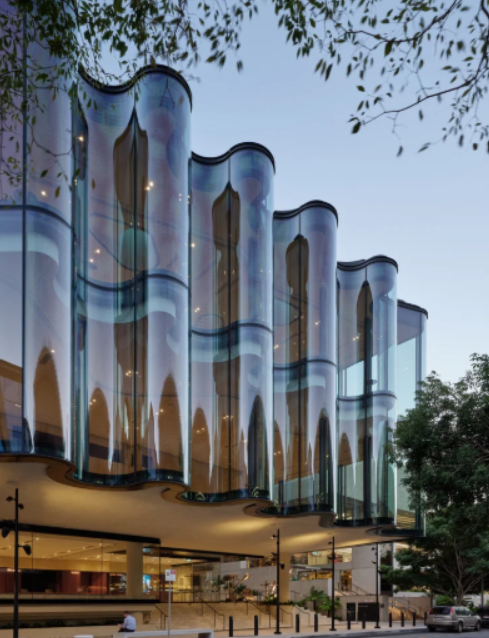
To achieve the required optical performance, NorthGlass reportedly developed a new generation of bending equipment specifically for the project and upgraded multiple stages of its production line. Significant advancements were made in roller-wave control, anisotropy reduction, and surface distortion management, critical factors for large-scale curved façade glass where reflected cityscapes and daylight conditions constantly expose imperfections.
The insulated laminated tempered units also needed to satisfy demanding structural and environmental performance criteria, balancing curvature with wind-load resistance, thermal insulation, safety compliance, and long-span stability. Maintaining dimensional accuracy across panels approaching semi-circular curvature represented a major manufacturing and quality-control challenge.
Beyond its visual impact, the project reflects a broader evolution within façade engineering: the transition from planar curtain walls toward highly expressive free-form envelopes that demand integration between digital modelling, precision fabrication, and advanced tempering technologies.
Source: Glass Balkan