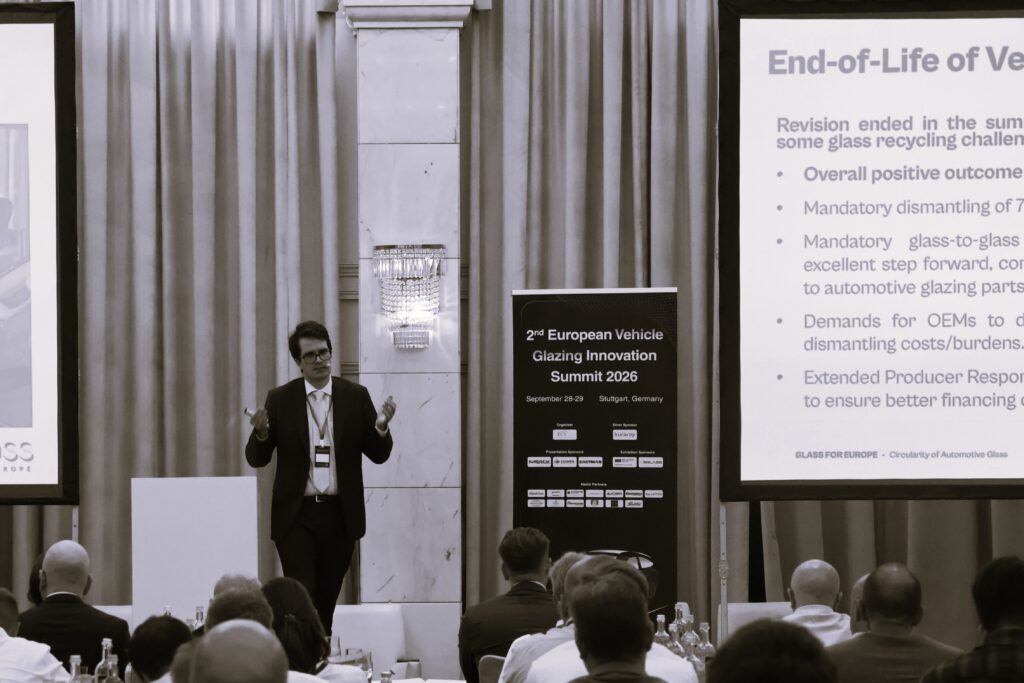
More than 100 professionals from across the automotive glass value chain gathered in Stuttgart, Germany, on 28–29 September for the second European Vehicle Glazing Innovation Summit 2026, focusing on developments, research and emerging trends in vehicle glazing.
Among the key topics was the circularity of automotive glass. Justin Loup, who oversees automotive product policy issues at Glass for Europe, presented the current state of automotive glazing recycling in Europe and discussed the opportunities and challenges associated with increasing recovery rates.
Automotive glass is currently rarely recycled, representing a significant opportunity to reduce raw material consumption, production energy use and associated CO₂ emissions. However, systematic dismantling and recycling also involve technical and economic challenges that have limited wider adoption.
The recently published End-of-Life Vehicles Regulation (ELVR) is expected to significantly change this landscape. The regulation will require the dismantling of most automotive glazing, representing around 70% of vehicle glass, and its recycling into glass. It also introduces Extended Producer Responsibility schemes intended to support end-of-life treatment. 
Future vehicle glazing will bring additional challenges. Cameras, sensors, advanced interlayers and solar technologies are increasingly integrated into glazing systems. Designing these components for efficient separation and dismantling will therefore be essential to enable effective glass recycling at the vehicle’s end of life.
Source: Glass for Europe with additional information added by Glass Balkan