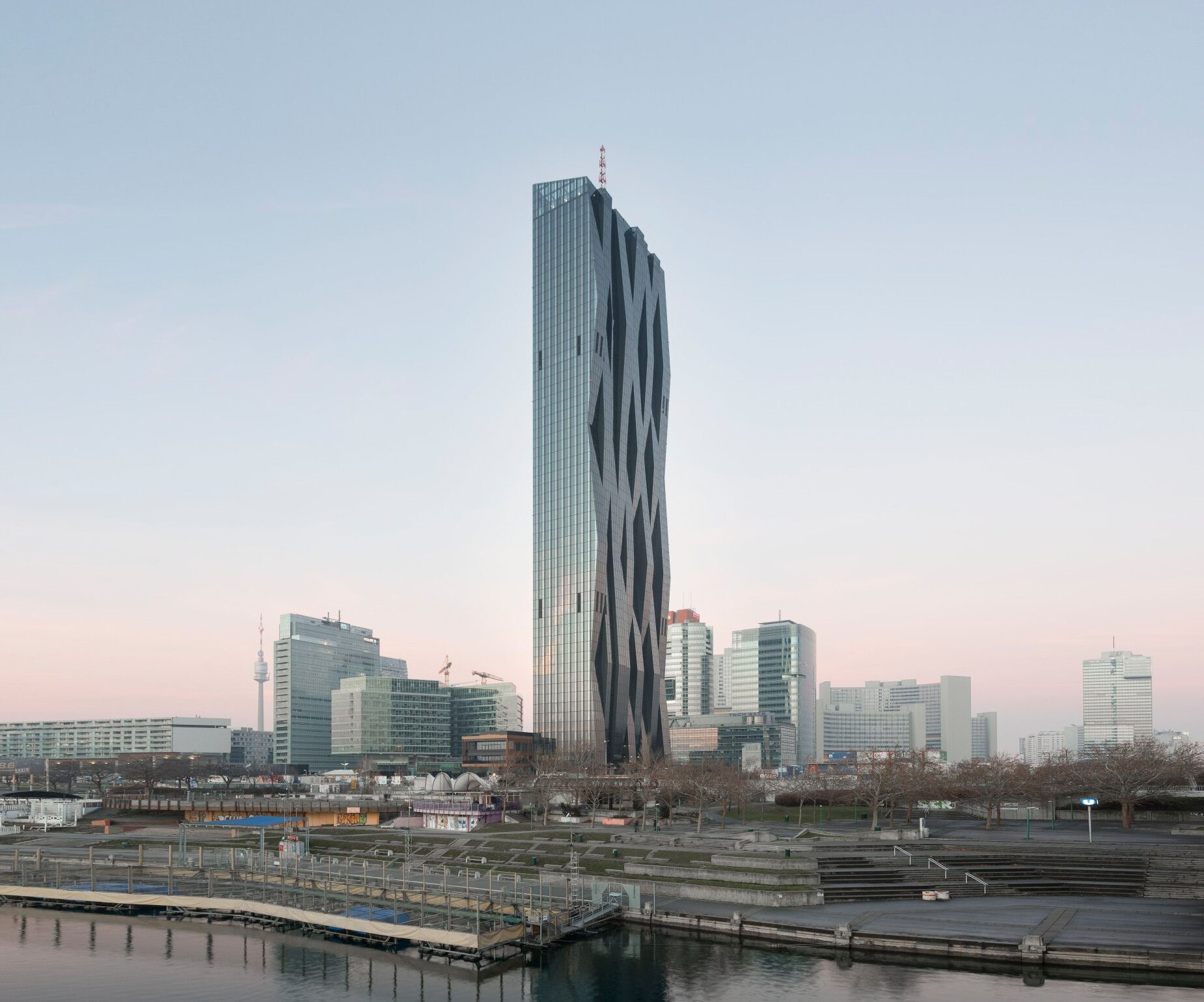
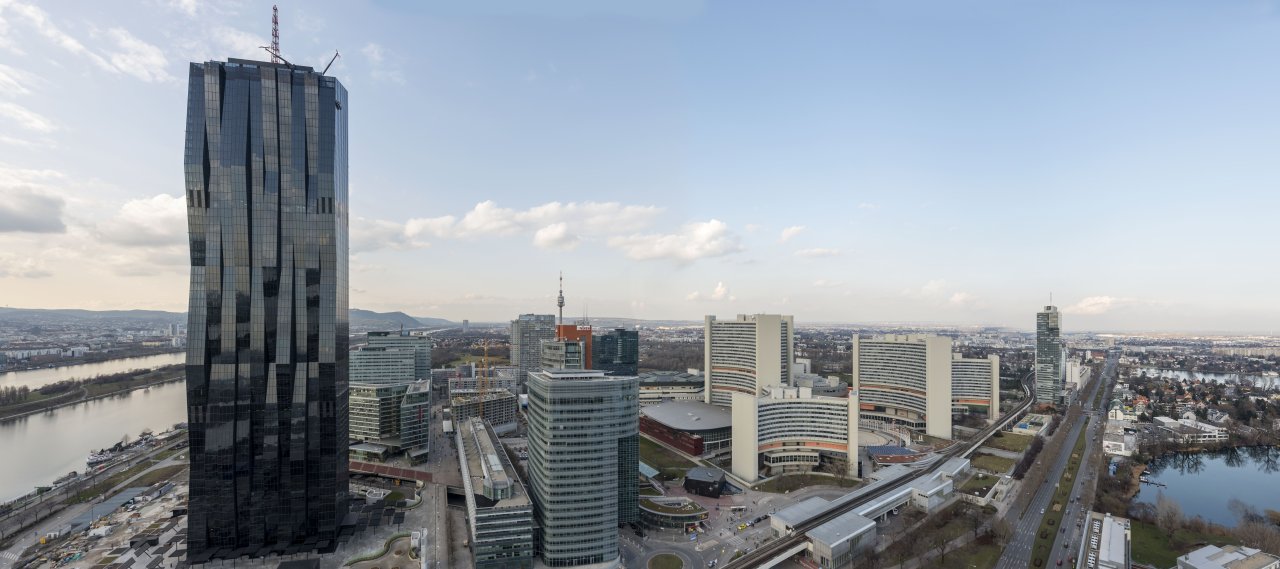
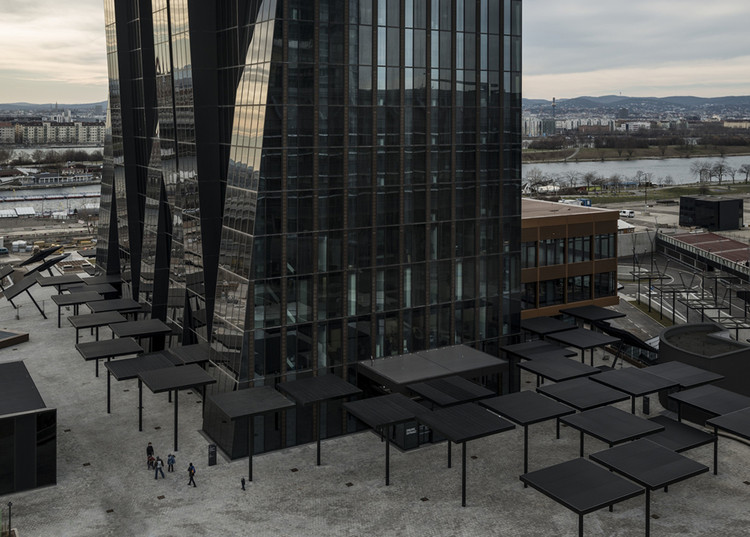
DC Tower 1 is the tallest completed building in Austria and a defining element of Vienna’s Donau City skyline. Located on the northern bank of the Danube, the project was developed as part of Vienna’s controlled high-rise expansion strategy, concentrating vertical density outside the historic city center while maintaining strict urban design regulations.
The tower was designed by Dominique Perrault Architecture in collaboration with Hoffmann-Janz Architekten. Planning began in 2005, with construction from 2010 to 2013 and completion in 2013–2014. The building stands at 220 meters structural height with 60 floors, and a gross floor area of approximately 93,600 m². Its total volume is around 500,000 m³, making it one of the largest mixed-use high-rises in Central Europe.
Structural System
The structural concept is based on a reinforced concrete core with perimeter column support and outrigger levels. The central core is the primary vertical and lateral load-resisting element and contains elevator shafts, staircases, and mechanical risers. It is designed to resist both gravity loads and significant wind-induced forces.
Perimeter columns are arranged in a regular grid with typical spans of 5.6–7.0 meters to flat reinforced concrete slabs. These slabs act as diaphragms transferring loads toward the core. At selected mechanical floors, outrigger systems connect the core to perimeter columns, reducing lateral drift and increasing torsional stiffness. 
This hybrid structural system allows the building to achieve a high slenderness ratio while maintaining controlled displacement under wind action.
Wind and Dynamic Behaviour
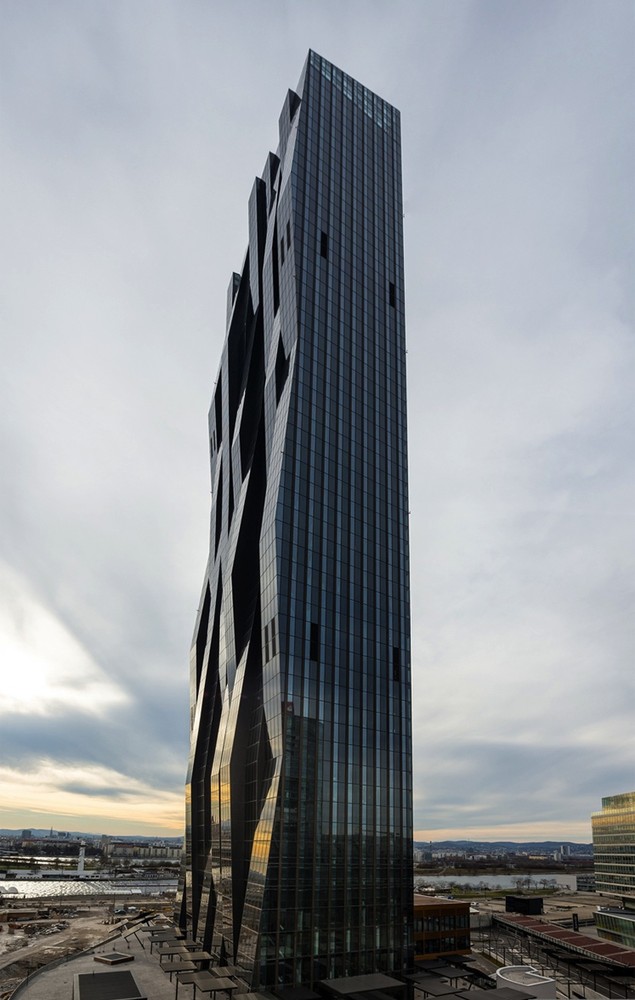
Wind loading is the governing horizontal design factor due to the tower’s exposed riverside location and height. Extensive wind tunnel testing was conducted during design development to assess vortex shedding effects and occupant comfort criteria.
To mitigate dynamic response, a tuned mass damper (TMD) system was integrated near the upper levels. This device counteracts building sway by moving out of phase with structural motion, reducing peak acceleration and improving comfort in upper floors, especially in hotel and residential zones.
Seismic and Geotechnical Design
The tower is designed according to Eurocode 8 and Austrian standard ÖNORM, placing Vienna in seismic zone 2 (low-to-moderate seismic risk). While seismic loads are secondary to wind, the structure is detailed for ductility and energy dissipation.
Foundation conditions consist of deep alluvial soils near the Danube, requiring a deep foundation system with piles transferring loads to competent bearing strata. Soil-structure interaction was an important factor in settlement control and lateral stability.
Façade Engineering
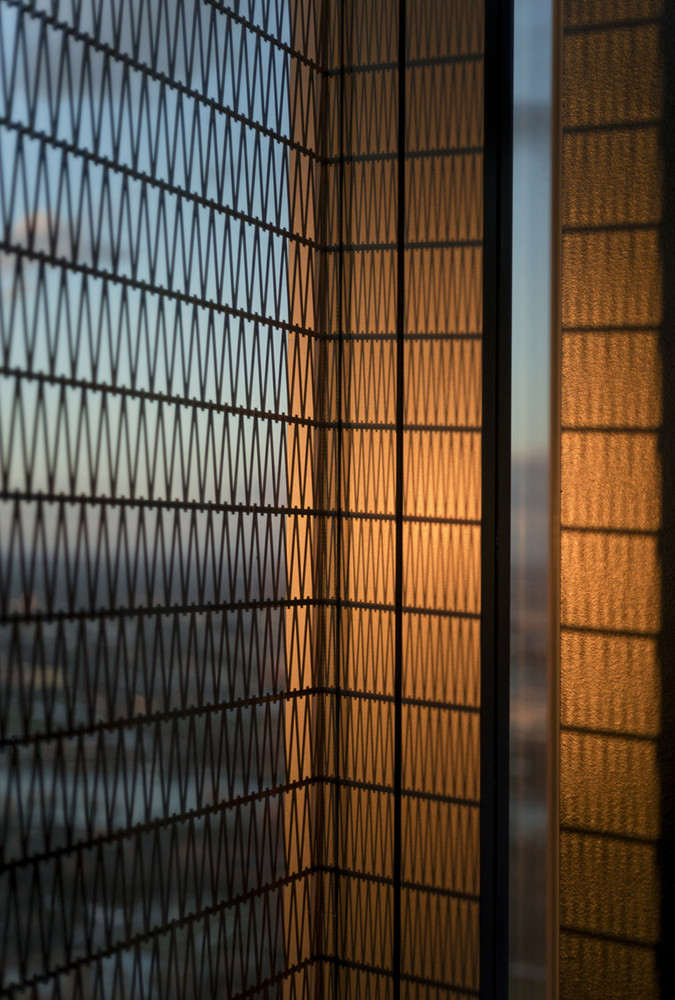
The building envelope is a high-performance curtain wall system with a faceted geometry. The façade is composed of triangular and planar glass panels that create a fragmented vertical surface, reducing monotony and enhancing reflectivity of sky and river light conditions.
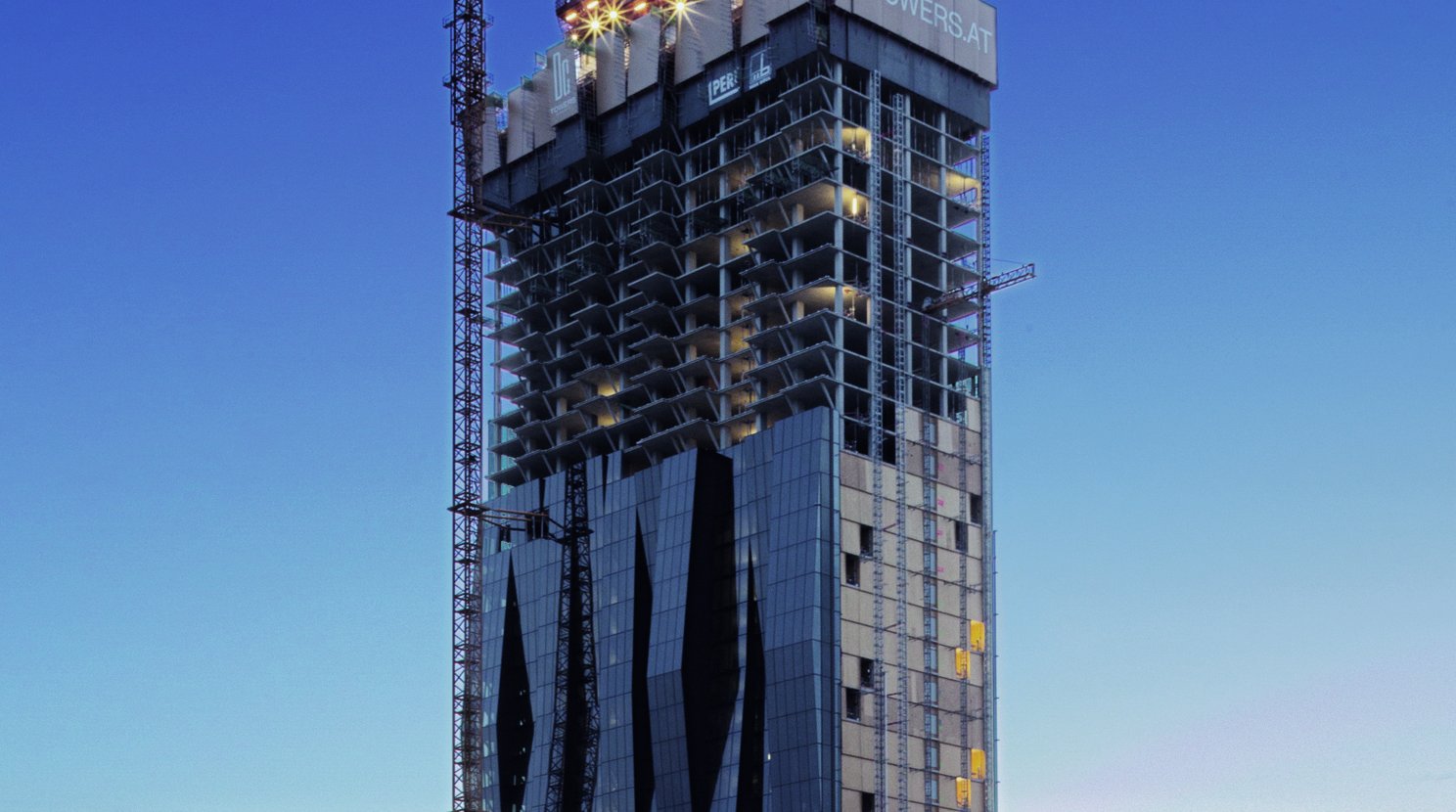
The façade incorporates:
- Double-glazed insulating units
- Solar control coatings
- Integrated shading performance through geometry rather than external fins
This system contributes to reduced cooling loads and supports the building’s LEED Platinum certification.
Functional Zoning
The tower is vertically zoned:
- Lower levels: office spaces with flexible floorplates
- Mid-levels: additional office and adaptable commercial areas
- Upper levels: hotel functions
- Top floors: restaurant and sky bar with panoramic views over Vienna
This mixed-use configuration ensures continuous occupancy and operational efficiency throughout the day.
Architectural Significance
DC Tower 1 is considered a benchmark in European high-rise design due to its integration of structural engineering, façade geometry, and environmental performance. It demonstrates how reinforced concrete core systems combined with outrigger technology can achieve significant height while maintaining strict comfort and sustainability standards.
The building has received multiple international recognitions, including the CTBUH Best Tall Building Europe Award (2014), reinforcing its status as a reference project in modern skyscraper engineering.
Source: Glass Balkan