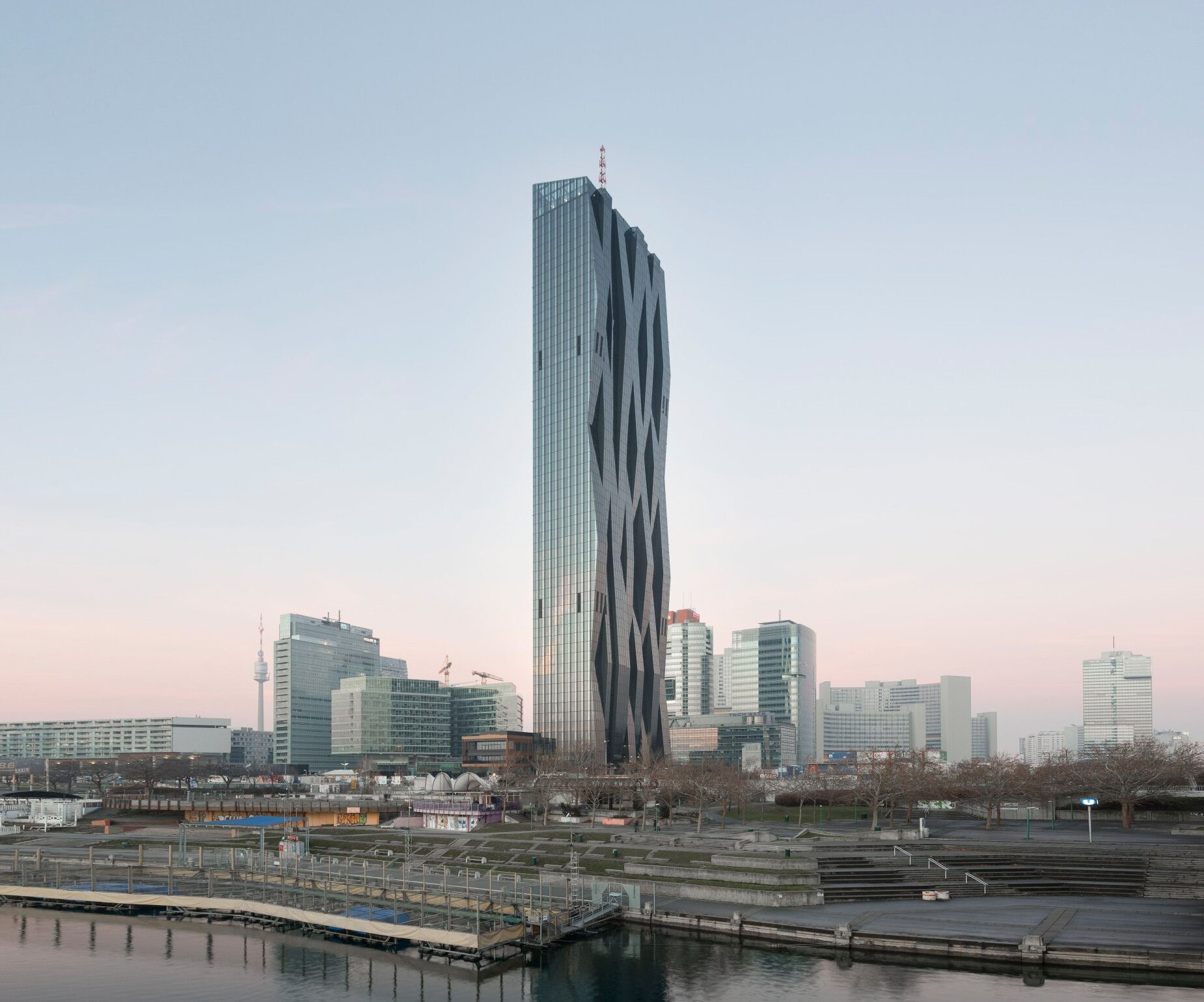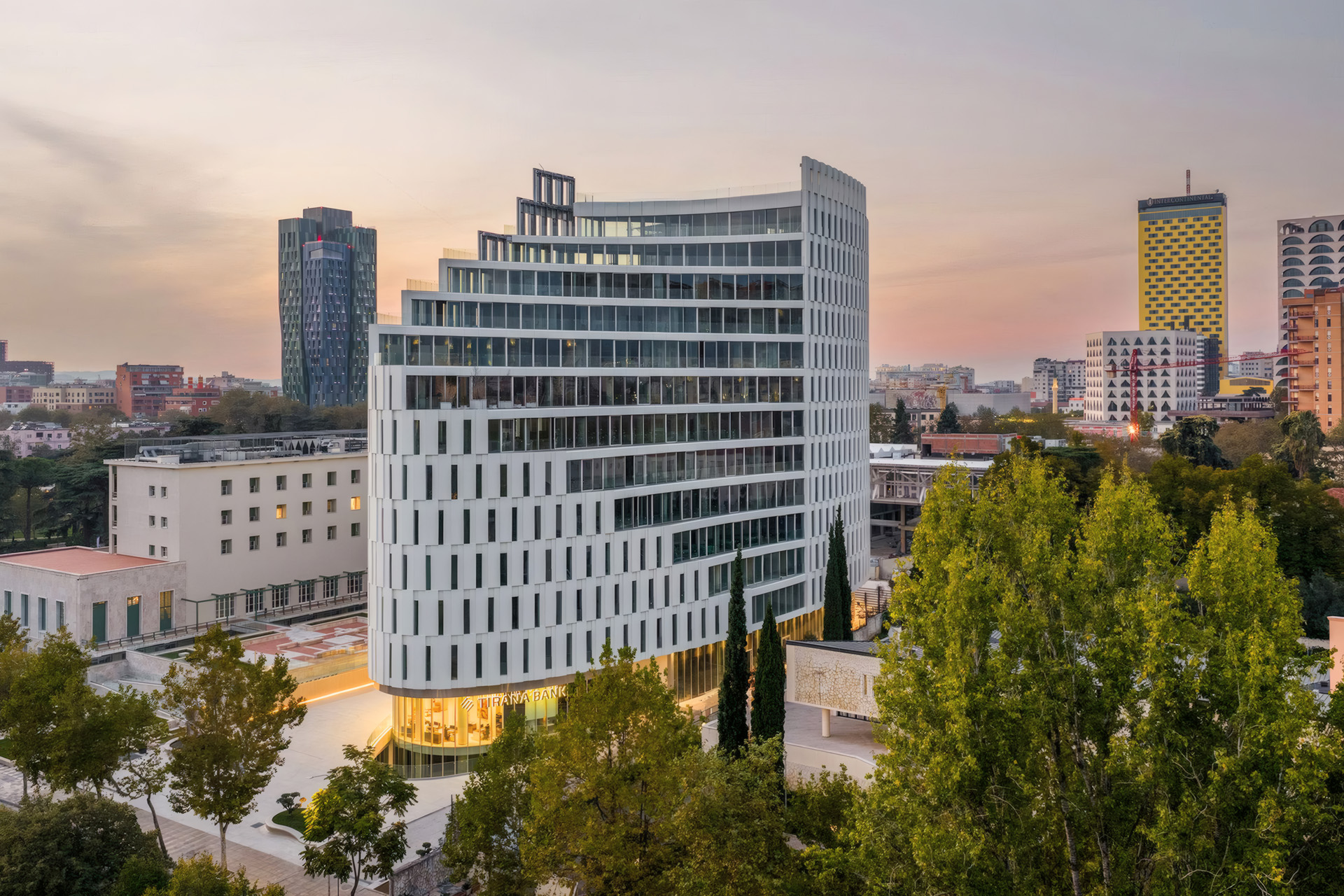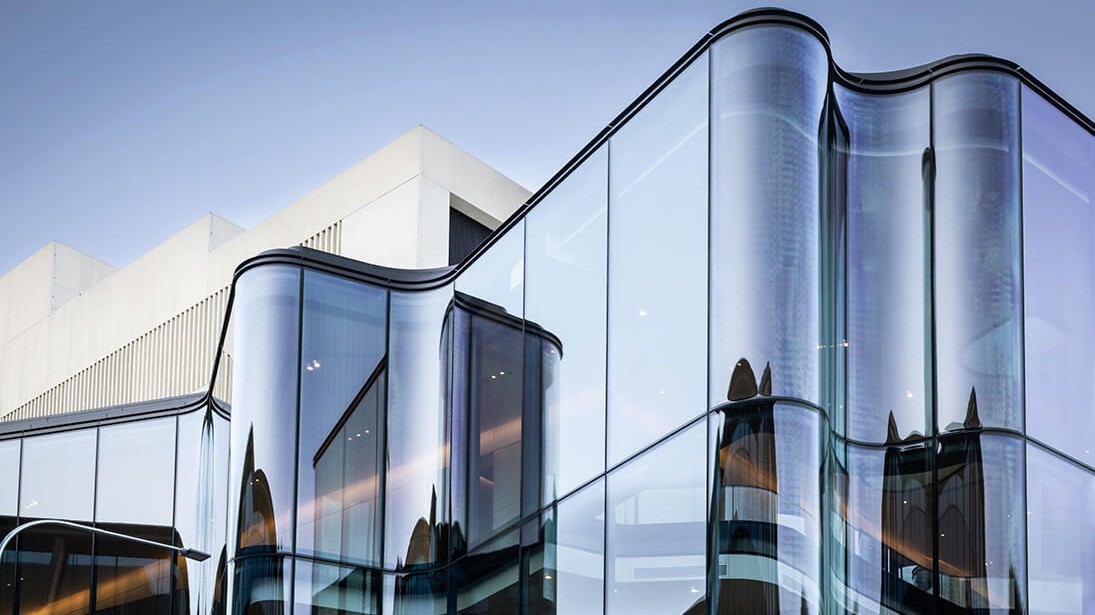
Curved glass is no longer an “exceptional component” reserved for signature architecture. It has become a technically viable façade system element that is actively reshaping how engineers define geometry, load transfer, tolerances, and interface behaviour. What has changed is not just manufacturing capability, but the engineering methodology behind how façades are conceived and validated.
1. Geometry is no longer descriptive, it is a manufacturing constraint
In conventional flat curtain wall systems, geometry is primarily a design output. With curved glass, geometry becomes an upstream constraint governed by industrial feasibility.
Key parameters that now define viability include:
- Minimum achievable radius, governed by bending method (hot-bent vs gravity-bent vs cold-formed laminated assemblies)
- Chord length vs arc length tolerance accumulation, which directly impacts edge alignment and mullion continuity
- Panel segmentation logic, where curvature must often be rationalised into “manufacturable families” rather than continuous variation
- Transport envelope limitations, which frequently override architectural intent before structural considerations even begin
In practice, façade engineering shifts from “detailing a form” to “negotiating a manufacturable geometry space”. 

2. Structural behaviour: curvature introduces anisotropic stiffness response
Unlike flat glass, which behaves predominantly as a plate under out-of-plane load, curved glass exhibits geometrically induced stiffness anisotropy.
This results in:
- Increased stiffness along the curved axis due to membrane action
- Reduced predictability of deflection under asymmetric wind loading
- Non-linear stress redistribution around fixings and edge restraints
- Sensitivity to local geometric imperfections introduced during bending (e.g. roller wave distortion, thickness variation in gravity bending)
For laminated curved units, post-fracture behaviour is also significantly less intuitive. Load redistribution across interlayers is not symmetric, and residual curvature can either stabilise or destabilise broken fragments depending on edge restraint conditions.
As a result, engineers often rely on:
- Non-linear finite element analysis (FEA) with geometric imperfection sensitivity
- Project-specific prototype testing for critical zones
- Conservative modification factors for deflection and stress validation where empirical data is limited
3. Interface engineering becomes the dominant risk driver
The highest failure risk in curved façades is rarely the glass itself—it is the interface system between curved units and predominantly rectilinear primary structures.
Critical interface challenges include:
- Tolerance stacking between steel fabrication, glass bending accuracy, and site installation deviation
- Misalignment between curved mullion geometry and straight structural grids
- Sealant bite consistency under variable curvature radii
- Edge support eccentricities introduced by non-planar contact conditions

This has led to widespread adoption of:
- Adjustable stainless-steel brackets with multi-axis tolerance compensation
- Compressible setting systems with controlled preload capacity
- Parametric interface detailing tied directly to fabrication shop drawings rather than design intent models
In high-performance façades, the interface is no longer a detail, it is a calibrated tolerance system.
4. Edge conditions: stress concentration is amplified, not reduced, by curvature
A common misconception is that curvature “smooths out” stress. In reality, it often relocates stress concentration zones rather than eliminating them.
Key technical observations:
- Drilled point fixings in curved monolithic or laminated glass introduce complex biaxial stress fields due to pre-bending
- Edge deletion zones in coatings must be more precisely controlled, as curvature amplifies local thermal gradients
- Gasket compression varies continuously along curved frames, making uniform sealing pressure physically unattainable without adaptive profiles
This is why many high-end curved systems avoid rigid point fixing altogether in favour of:
- Linear edge capture systems with continuous load distribution
- Structurally glazed silicone joints with calibrated bite geometry
- Hybrid systems combining mechanical restraint at discrete nodes with continuous elastic bedding

5. Thermal and acoustic performance: second-order effects become first-order design drivers
While U-values and SHGC values remain governed by IGU specification, curved geometry introduces secondary performance distortions that must be explicitly modelled:
Thermal:
- Spacer bar geometry distortion affects edge-of-glass thermal bridging
- Non-uniform cavity thickness in some bending processes influences gas retention stability
- Coating uniformity becomes sensitive to curvature-induced deposition variation
Acoustic:
- Curvature modifies reflection paths, often reducing specular reflection but increasing diffuse scattering
- Certain radii can generate focal reflection zones if interior geometry aligns with concave surfaces
- Joint frequency becomes a dominant acoustic leakage variable due to non-linear perimeter length variation
As a result, façade engineering now routinely requires coupled thermal-acoustic-geometry simulations, rather than isolated performance checks.
6. Installation engineering: sequencing is a structural system in itself
Curved glass installation cannot be treated as a construction phase—it is an engineered sequence.
Key constraints include:
- Each panel is geometrically unique, eliminating interchangeability and increasing handling risk
- Suction lifting systems must account for curvature-induced pressure distribution variation
- Installation tolerances must be absorbed in the frame, not in the glass unit
- Progressive alignment errors accumulate along curvature lines, requiring “reset zones” in long spans

Best-practice methodology includes:
- Digitally controlled installation grids with real-time survey feedback (laser scanning / total station verification)
- Pre-assembled sub-frame modules matched to specific radius segments
- Defined tolerance absorption hierarchy (structure → bracket → gasket → sealant → glass position)
7. Engineering decision-making: when curvature is justified
From a façade engineering perspective, curved glass is only rational when it satisfies at least one of the following criteria:
- It resolves a geometric discontinuity problem that would otherwise require inefficient faceting
- It improves aerodynamic or wind-flow behaviour in high-rise envelope conditions
- It enhances daylight distribution or visual comfort through controlled reflection geometry
- It is structurally integrated into the architectural concept rather than applied as a surface effect
If none of these conditions are met, curvature becomes a cost-and-risk multiplier rather than a performance solution.
Curved glass fundamentally redefines façade engineering from a deterministic detailing discipline into a probabilistic, tolerance-driven system of integrated constraints. Success is no longer determined by the elegance of a section detail alone, but by the coherence between geometry, fabrication capability, structural behaviour, and installation logic. In this sense, curved glass does not simply change façade aesthetics, it changes the engineering epistemology of the façade itself.
Source: Glass Balkan