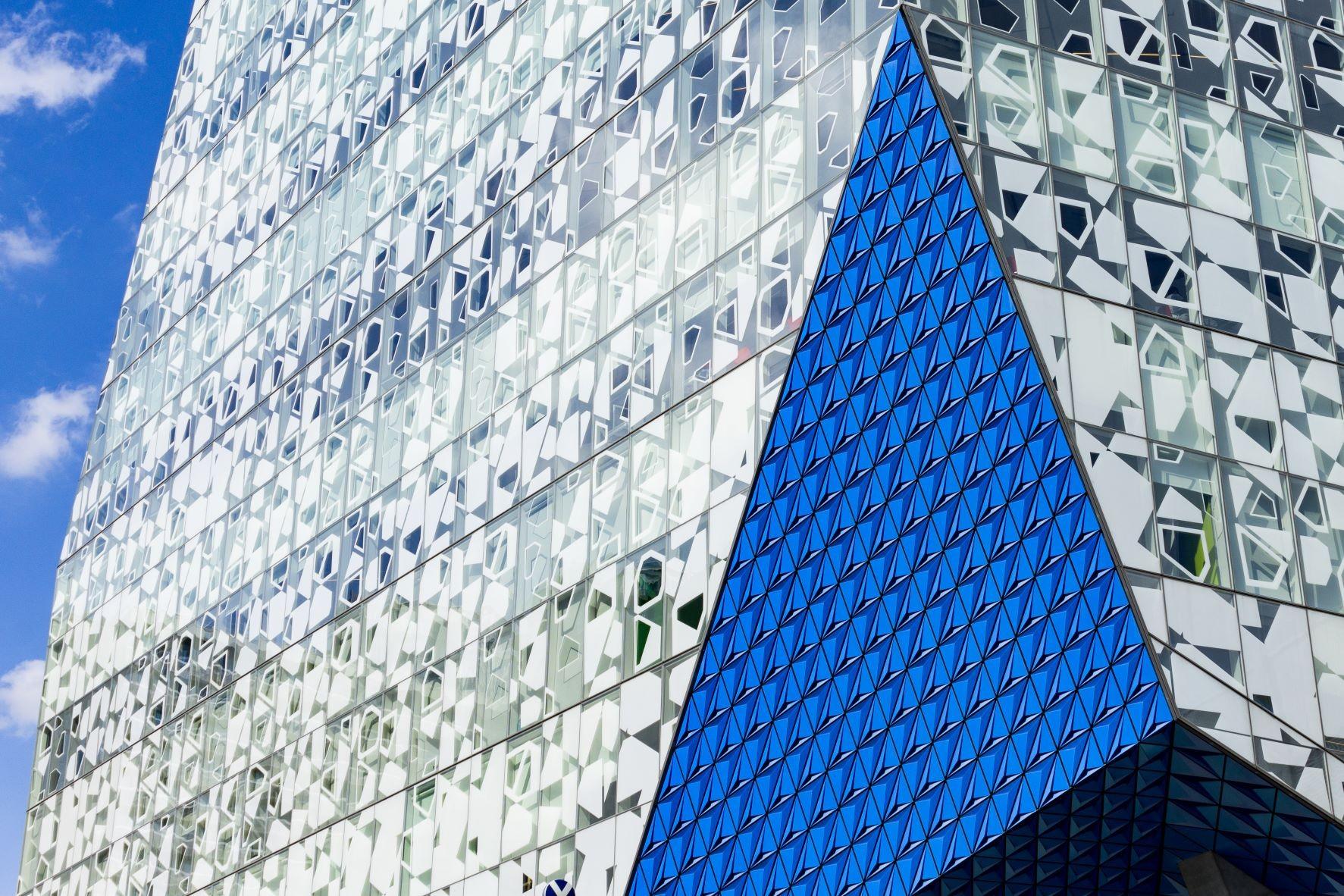
Printed glass is often specified for its appearance, but its ceramic coating also influences daylight transmission, solar heat gain and the optical performance of façades. The result depends on several variables, including ink colour, printing coverage, glass composition and the position of the printed surface within the glazing unit.
Fused, not painted
Architectural ceramic printing uses specialised inks containing ceramic particles, applied through screen-printing or digital inkjet technology. The glass is subsequently heat-treated, typically at temperatures above 600°C, fusing the ceramic material permanently to its surface. Unlike organic paints, fired ceramic coatings offer high resistance to UV radiation and weathering.
Screen printing transfers ceramic enamel through a mesh, making it suitable for repetitive patterns and large production runs. Digital printing deposits ink directly onto the glass, allowing more complex designs, gradients and multicolour images without dedicated printing screens.
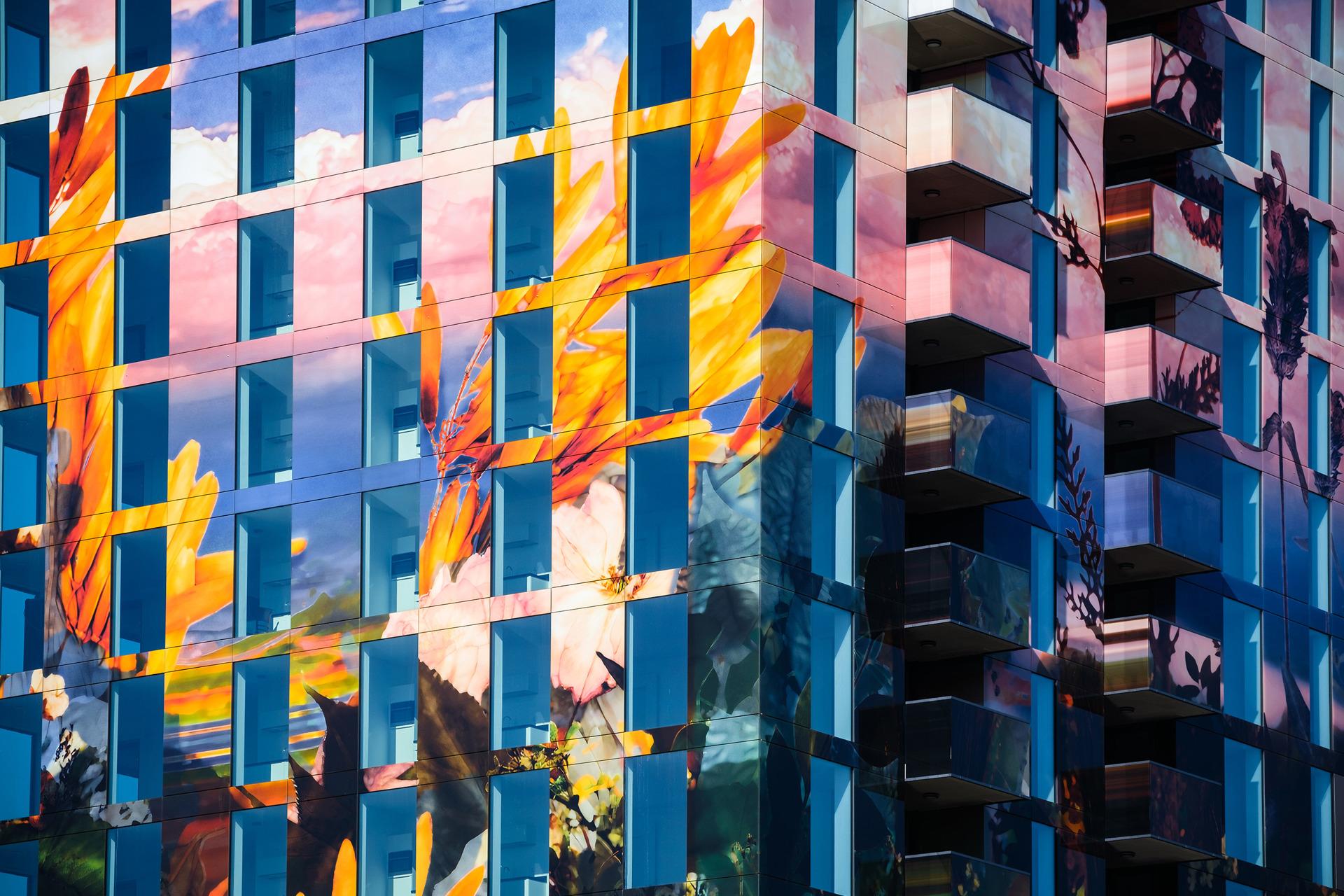
Production capabilities vary considerably. Pilkington DesignPrint supports resolutions up to 1,440 dpi, glass thicknesses from 4 to 19 mm and dimensions up to 2,500 × 4,500 mm. Press Glass specifies a maximum format of 3,200 × 7,000 mm, depending on glass thickness. 
Colour changes light transmission
One of the less obvious characteristics of printed glass is how strongly ceramic colour influences visible light transmission (LT).
Research by Wilson and Elstner, published in Challenging Glass 6 (2018), measured three ceramic frit colours on 6 mm low-iron glass. Calculated according to EN 410, white frit (RAL 9010) achieved light transmission of 0.320, compared with 0.035 for dusty grey (RAL 7037) and virtually zero for black (RAL 9005).
Solar energy transmittance followed a similar pattern: 0.337 for white, 0.099 for grey and 0.004 for black. These measurements describe the printed samples, not complete insulating glass units.
More printing does not always mean less solar heat
The solar factor (g-value) represents the total solar energy entering a building, including directly transmitted radiation and heat re-emitted inward after absorption.
Increasing frit coverage can reduce direct solar transmission, but darker colours absorb more energy. Part of that absorbed heat can subsequently enter the building, meaning a higher coverage does not automatically produce a lower g-value.
The position of the ceramic layer and its relationship with low-emissivity coatings also influence the final result. Consequently, solar performance must be evaluated for the complete glazing configuration rather than inferred from the printed surface alone.
Printed glass and solar power
A 2026 study published in Materials examined nine ceramic-printed glass samples for building-integrated photovoltaics (BIPV). The printed covers generally achieved visible transmission between 60% and 80%, compared with approximately 90% for the 4 mm low-iron reference glass.
In laboratory testing, the reference photovoltaic cell produced 1.70 W with Optiwhite glass. The best printed sample produced 1.41 W, while the lowest-performing sample delivered 1.16 W, representing reductions of approximately 17% and 32%, respectively.
These results demonstrate how decorative printing can influence electricity generation when incorporated into photovoltaic glazing.
What should be specified?
For architects and façade engineers, evaluating printed glass requires more than selecting a colour or pattern. Important parameters include printing method, frit colour, surface coverage, glass thickness and print position.
Technical specifications should include visible light transmission, solar energy transmittance, g-value, light reflectance and Ug-value for the complete glazing unit. Measurements should also account for light scattering, which can influence reported optical values.
Printed glass is therefore more than a decorative treatment. Its ceramic surface can become an active component of façade design, influencing daylight, solar control and even photovoltaic performance.
Source: Glass Balkan