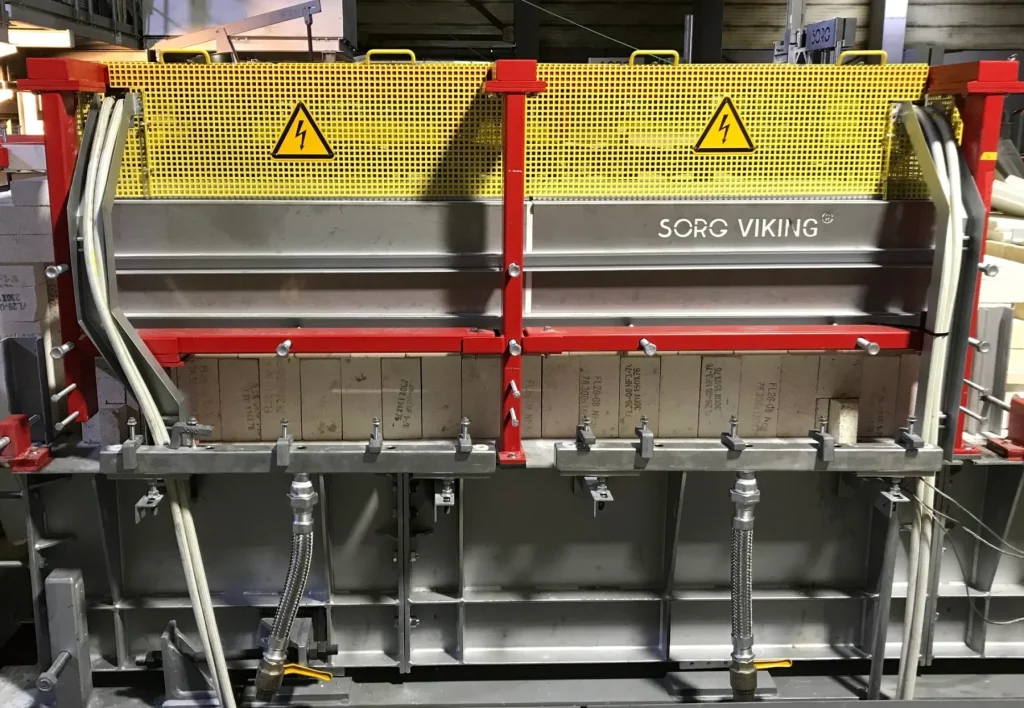
SORG Group has reached a major milestone in the decarbonisation of glass production with the successful long-term industrial operation of its fully electric VIKING® forehearth. Following extended large-scale use on an operating glass melting furnace, the system has demonstrated stable, reliable performance under real production conditions.
Glass conditioning remains one of the most significant sources of CO₂ emissions in the glass manufacturing process. While electrically heated forehearths have existed for years, their adoption has been limited by technical challenges such as contamination from heating elements, uneven temperature distribution, slow thermal response, and accelerated wear. These constraints have historically restricted electric conditioning to niche or low-tonnage applications.
The VIKING® forehearth changes this landscape by enabling 100 % electric glass conditioning for all tonnages. Its key innovation lies in heating elements that are fully integrated into a specially designed superstructure. This configuration eliminates local overheating, ensures uniform temperature control, and prevents any heating element material from coming into contact with the glass melt, effectively removing contamination risks and improving product quality.
Installed at an industrial production facility, the VIKING® forehearth was equipped with an emergency gas heating system purely as a safety backup. In practice, this system has not been required, with the electric forehearth delivering consistent and precise conditioning throughout long-term operation. 
The successful deployment of the VIKING® forehearth complements SORG’s wider portfolio of low- and zero-carbon technologies. Together with the VSM® and VSM+® fully electric melting systems and the CLEAN Melter® hybrid furnace, which can reduce CO₂ emissions by up to 80 percent, SORG now offers a complete technological pathway toward fully CO₂-free glass production, from melting to conditioned glass.
Source: SORG with additional information added by Glass Balkan