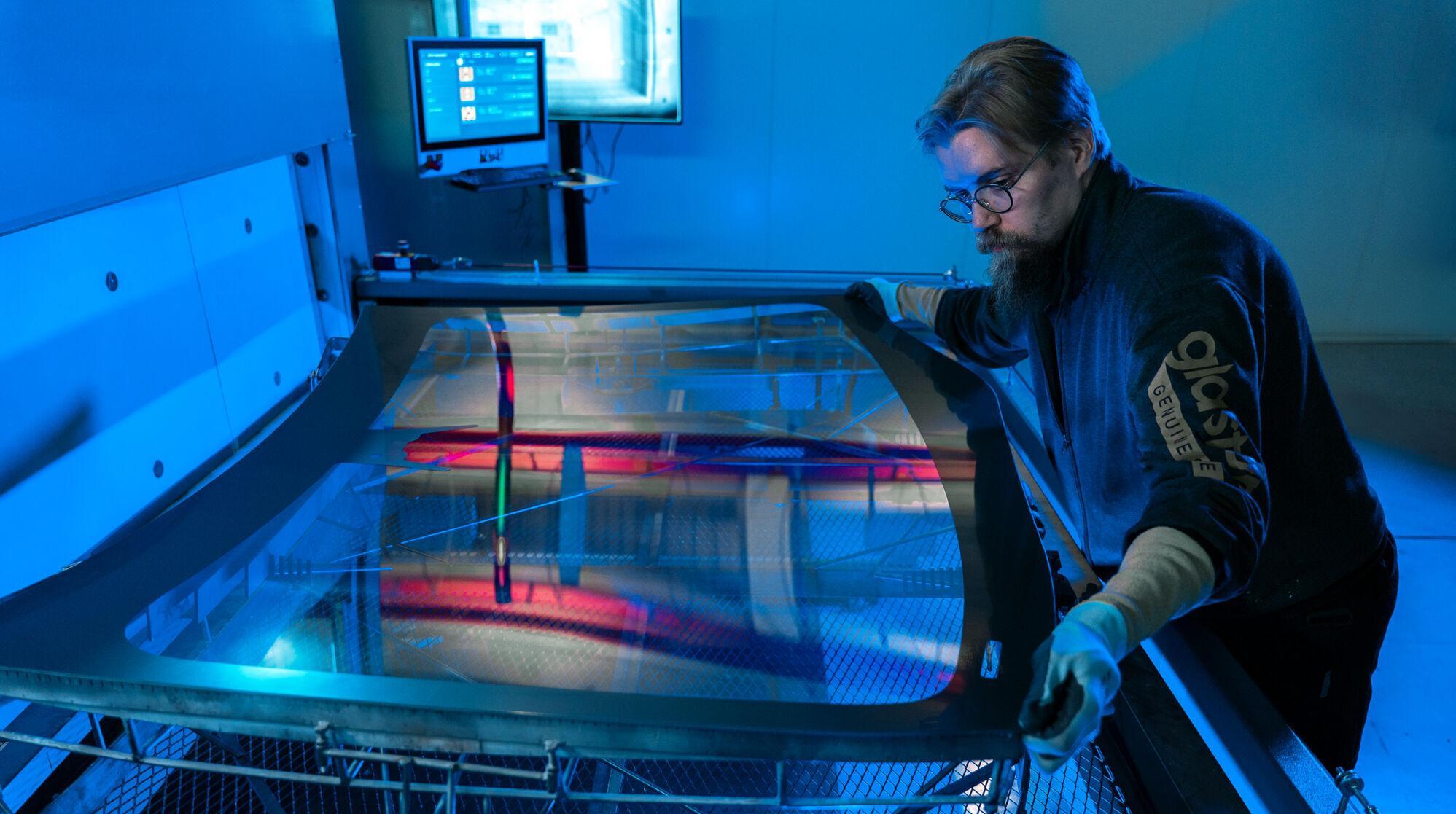
The automotive glass segment is entering a phase where optical perfection is not a premium feature anymore, it is the baseline requirement. As OEMs push for larger glazing areas, tighter tolerances, and advanced sensor integration, glass processors are under pressure to deliver consistent optics, high yield, and repeatable performance across every production stage.
Over the last two years, Glaston has secured multiple automotive glass processing deals across key global markets including Japan, China, Croatia, South Africa, the United States, and Brazil, confirming continued momentum for its automotive portfolio. In these projects, customers selected MATRIX, MATRIX EVO and CHAMP EVO solutions for their ability to meet modern production demands while delivering consistently superior optical quality.
Market evolution: from size to complexity to ADAS requirements
Automotive glass production has changed rapidly over the last two decades. The early 2000s shifted demand toward larger glass sizes, enabling improved driver visibility and cleaner vehicle design. That trend was followed by increasingly complex geometries, with car models such as the Mini highlighting how styling decisions can intensify bending and processing difficulty.
Today, the transition toward electric and autonomous vehicles has introduced the most demanding challenge yet: modern vehicles depend on ADAS cameras, sensors, and communication systems that must function behind glass surfaces without distortion, optical deviation, or inconsistent reflections. 
Production requires application-specific control
Automotive glazing demands controlled quality across multiple product types:
- Windshields require lamination to meet safety and performance standards
- Sidelites increasingly require both tempering and lamination, supporting safety, noise reduction, and passenger comfort
- Backlights are becoming more complex in shape and function, requiring higher process precision for reliability and visibility
To maintain quality throughout, equipment must support every step, from pre-processing through laminating and tempering, with stable repeatability.
End-to-end capability under one technology partner
Glaston positions itself as a single partner for automotive glass production, delivering processing solutions built to handle more complex shapes, higher throughput, and tighter optical requirements.
MATRIX and MATRIX EVO are engineered for single-model and mixed production of windshields and sunroofs, offering strong bending stability even for complicated geometries. Their use of active convection preheating supports uniform temperature distribution, improving optical quality, boosting yield, and reducing energy consumption and operating costs.
CHAMP EVO supports precision pre-processing with high efficiency, combining cutting, breaking, and grinding with short cycle times and high repetition accuracy. Its automated, flexible layout enables rapid changeovers and supports advanced tempering requirements in demanding production environments.
One of the strongest performance indicators in Glaston’s automotive offering is its windshield production capability delivering yields of up to 99.5%, backed by technology continuously refined since 1971. Recent advances in automation further improve repeatability at every stage, helping processors improve throughput, reduce waste, and strengthen profitability under stricter OEM requirements.
Source: Glaston with additional information added by Glass Balkan