In glass tempering, quenching accounts for a significant share of total line energy consumption. High-power blower systems must generate large air volumes at precisely controlled pressures to cool glass sheets typically ranging from 3 mm to 19 mm in thickness. These systems must also react rapidly to frequent recipe changes, especially in mixed production environments.
Traditional tempering blowers use welded steel impellers, which typically weigh several times more than composite alternatives. This high mass results in high rotational inertia, limiting acceleration and deceleration rates. As a consequence, steel impellers cannot be slowed down efficiently between glass loads and often continue running at near-production speed during idle periods. Even short waiting times between cycles therefore lead to continuous power draw and unnecessary electricity consumption.
In addition, welded steel impellers are exposed to cyclic mechanical stress. Rapid speed changes place concentrated loads on welded joints, bearings and shafts. Over time, this leads to material fatigue, increased vibration, higher bearing wear and an elevated risk of mechanical failure.
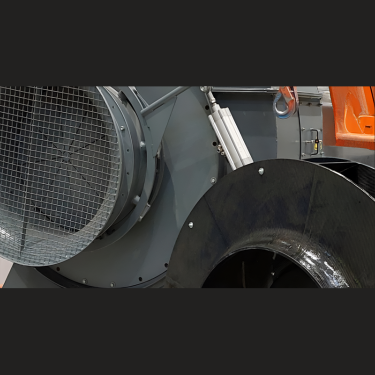
Glaston’s carbon fibre impeller technology replaces steel with a lightweight, high-strength composite structure, drastically reducing rotational mass. This allows blower speed to be adjusted dynamically based on the tempering recipe and real-time process demand. During waiting periods, blower speed can be reduced immediately instead of remaining at full output. 
In thin-glass production (typically 3–6 mm), this dynamic control enables up to 20% lower cooling energy consumption per cycle. In mixed production, where frequent thickness changes normally prevent speed optimisation, carbon fibre impellers still deliver consistent energy savings by matching airflow precisely to required cooling intensity.
Mechanically, the reduced mass lowers loads on bearings, shafts and motor drives, improving long-term reliability. Carbon fibre impellers are inherently resistant to fatigue, allowing them to withstand thousands of rapid speed changes without structural degradation. This extends service life, reduces maintenance intervals and minimises unplanned downtime.
The solution is available for both new tempering lines and retrofits. Glaston’s delivery includes impeller installation, precision balancing and on-site optimisation of blower control parameters, ensuring stable airflow, reduced vibration and maximum efficiency from commissioning onward.
Source: Glaston with additional information added by Glass Balkan