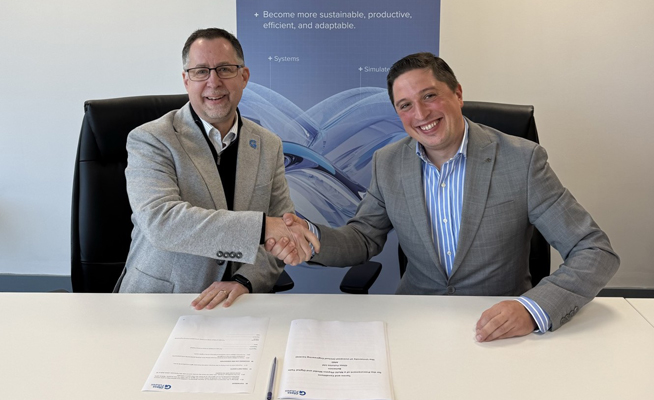
Glass Futures has partnered with the University of Liverpool’s Virtual Engineering Centre (VEC) to introduce AI-GLASS, a pioneering digital twin project designed to support decarbonisation and reshape innovation in the glass manufacturing sector. Backed by £1.5 million in UKRI funding, the initiative aims to help manufacturers transition toward cleaner fuels, reduce energy use and adopt advanced digital tools with confidence.
Developed at Glass Futures’ 165,000 sq ft Global Centre of Excellence in St Helens, AI-GLASS creates a highly detailed virtual replica of the glass production process. By combining artificial intelligence with physics-based modelling and real-time data, the platform allows manufacturers to safely test new technologies and process adjustments without interrupting live operations or risking equipment. This includes trials with low-carbon solutions such as hydrogen, biofuels and electrification pathways.
The system can instantly predict how changes in fuel, energy input or batch composition will affect melt quality, emissions, operating costs and furnace performance. This level of insight makes decision-making faster, more reliable and significantly more sustainable. 
A central element of AI-GLASS is its immersive 3D digital twin of the entire Glass Futures site, developed using BIM modelling, LiDAR scanning and UAV photogrammetry. This photorealistic environment will support training, remote walkthroughs, safety planning and live operational visualisation.
Dr Konstantin Vikhorev, Chief Technology Officer at the VEC, said the platform will completely transform how decarbonisation strategies are tested. By enabling manufacturers to run simulations “in seconds,” AI-GLASS reduces risk and speeds up the adoption of low-carbon solutions.
Glass Futures CEO Justin Kelly emphasised the strength of collaboration in tackling global sustainability goals. By pairing digital simulation with AI, he explained, the industry can innovate without disruption, improving efficiency, cutting emissions and maintaining product quality.
AI-GLASS builds on previous research at the facility showing that sustainable biofuels can reduce carbon emissions by up to 80 percent. With this new digital capability, the UK further strengthens its position as a leader in industrial digitalisation and clean manufacturing.
Source: growthplatform.org with additional information added by Glass Balkan