The Advanced Building Skins Conference & Expo (ABS Bern) 2026 featured five presentations examining developments in insulating glass, advanced coatings, passive cooling, structural reinforcement and architectural lighting. The subjects ranged from measuring the long-term condition of insulating glass units to incorporating lighting directly into façade framing systems.
1. Insulating Glass: Long-Term Performance
The thermal performance of insulating glass units (IGUs) depends on their ability to retain insulating gas and maintain the integrity of their edge seals. However, laboratory durability tests do not necessarily reflect the condition of glazing after decades in service.
Chris Davis, Business Development at H.B. Fuller, presented findings from a field survey covering five commercial buildings in London. The investigation examined 1,116 insulating glass units, with measured remaining gas concentrations ranging from approximately 1% to 90%.
The study also included emissivity measurements to assess the condition of glass coatings. Davis discussed a Dynamic Carbon Modelling Project examining how IGU degradation affects building energy consumption and carbon emissions over time. 
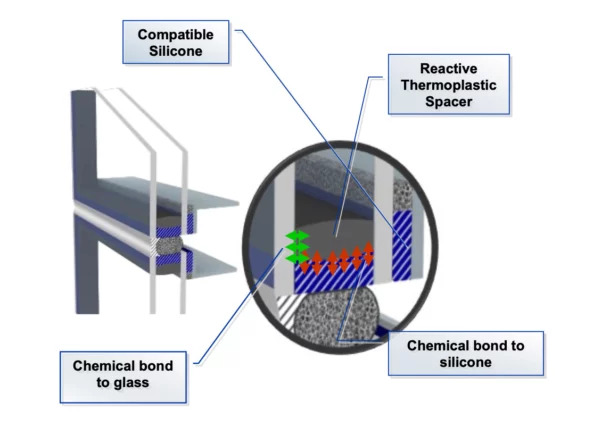
He also presented H.B. Fuller’s fusion bonding technology, which combines bonding processes with robotic application. The approach aims to improve manufacturing consistency and the durability of insulating glass systems.
2. Patterned Coatings for Architectural Glass
Glass coatings are commonly used to control solar radiation, heat transfer and light transmission. Marcus Frank of Bühler Group presented a technology that introduces customised patterns alongside these functional properties.
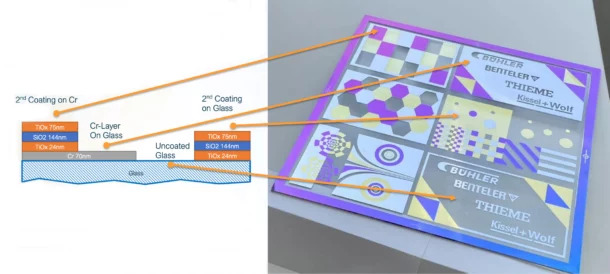
Developed through Bühler’s Leybold Optics business unit, the process combines printing technologies with physical vapour deposition (PVD).
It begins with screen or digital printing to create a masking pattern on the glass. Following a heating stage, the glass enters the PVD coating process. The coating material is deposited on exposed areas, after which the masking material is removed, leaving the intended pattern.
Potential applications include bird-friendly glazing, where surface patterns increase glass visibility to birds while limiting their visual impact from inside buildings. The process also allows graphics, corporate identities and decorative designs to be incorporated directly into glass surfaces.
3. Fluorescent Coatings for Passive Cooling
Coloured building surfaces present a challenge for thermal management. Darker colours absorb more solar radiation, while lighter surfaces generally reflect more sunlight.
Kaixin Lin of City University of Hong Kong presented research into fluorescent coatings designed for passive radiative cooling.
Inspired partly by natural fluorescence in corals, the technology uses materials that absorb light and subsequently re-emit it at a different wavelength, producing visible colour. The research employs a bilayer coating architecture intended to maintain high solar reflectance while achieving the desired colour effect.
Demonstrations include an application at the Coliseum in Hong Kong and installations on private residential rooftops. Potential substrates include metals, polymers and textiles.
For façade applications, the research aims to develop coloured surfaces that contribute to reducing solar heat absorption rather than serving purely decorative purposes.
4. Memory Steel for Concrete Reinforcement
Daniel Schmidig, CEO of re-fer, presented memory-steel reinforcement as an alternative approach to improving concrete performance while reducing material consumption.
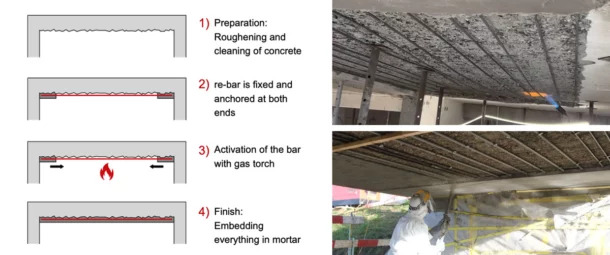
The steel has shape-memory properties. Following mechanical elongation during manufacturing, the bars are installed and fixed within concrete or mortar. When activated by heat, they attempt to recover their original shape, generating tension and transferring compressive forces to the surrounding material.
Available reinforcement diameters include 10 mm and 16 mm.
The resulting prestressing forces help control cracking and deformation. Applications include strengthening existing structures, repairing cracks in historic buildings and restoring concrete elements affected by corrosion. The technology can also reduce the need for demolition during renovation.
For façade engineering, its potential lies in developing slimmer, lighter concrete elements while maintaining structural requirements.
5. Integrating Lighting into Façade Systems
Architectural lighting is frequently treated as additional equipment installed after the main façade has been designed. Vladimir Grigorik of GVA Lighting presented an approach that incorporates lighting into the façade system from the beginning.
His presentation included projects such as Block 185, the Deloitte building in Montreal, the Figge Museum and 270 Park Avenue in New York.
One example involved integrating a lighting rail directly into an aluminium frame. This reduces the need for separately attached visible components and makes lighting part of the façade assembly.
The approach requires coordination between architects, façade consultants, aluminium manufacturers and lighting specialists. Installation, maintenance access and long-term operation must also be considered during the design stage.
Material Development at ABS Bern
The five presentations addressed specific technical challenges in building envelope design: insulating glass degradation, patterned functional coatings, solar heat absorption, concrete reinforcement and façade-integrated lighting.
The technologies differ in their development and application. The London IGU survey provides field measurements of installed glazing, while the fluorescent coatings are supported by practical demonstrations and ongoing research. The other presentations focused on manufacturing processes and construction applications.
Source: