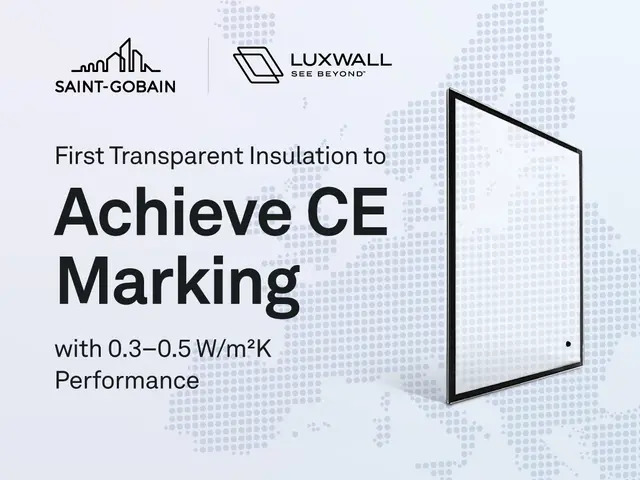
Saint-Gobain Glass has officially turned what once sounded like science fiction into a commercial reality. Its next-generation vacuum glazing solution, INSIO®, has obtained voluntary CE marking, making it the first tempered vacuum insulating glazing in the world to achieve this certification with thermal performance levels as low as 0.3–0.5 W/m²K.
For context, these insulation values outperform standard triple glazing, yet the glass remains significantly thinner. In other words, architecture can now move toward slimmer profiles without sacrificing thermal comfort or energy efficiency.
Certification Through EOTA Route
The CE marking was granted following the EOTA route for Vacuum Insulating Glass Units (EAD 300021-00-0404 / ETA 25/0363). This confirms that the complete INSIO® range meets strict European safety, durability, and performance criteria, giving designers and specifiers confidence to integrate vacuum glazing in both new developments and renovation projects across the European Economic Area.
LuxWall Partnership Strengthens Innovation Path
This certification milestone comes shortly after Saint-Gobain Glass’ partnership with LuxWall, an American leader in Transparent Insulation technologies. LuxWall’s vacuum insulation platform is now at the core of INSIO®, enabling the product to reach ultra-low thermal conductivity without adding bulk. 
Fabrice Desmons, International Marketing Director Building Glass at Saint-Gobain, highlighted that earning CE marking signals a major shift in the building envelope. According to him, it positions glass not as a weak thermal point, but as a high-performance contributor to decarbonization goals.
Echoing this view, LuxWall’s CEO Scott Thomsen emphasized that real-world reliability requirements have officially been met, meaning adoption at scale is now realistic, not experimental.
A Seamless Fit for Existing Window Systems
Another strong advantage: CLIMAPLUS® INSIO®, the double-glazed version already CE marked, can be installed in conventional window frames. That means homeowners, façade consultants, and developers can achieve vacuum-grade performance without redesigning profiles or complicating installation logistics.
Turning Glass Into an Energy Asset
What once made glass the weakest link in façade energy performance now becomes its strength. By combining ultra-thin tempered vacuum glass with world-leading insulation metrics, Saint-Gobain Glass and LuxWall are redefining how building envelopes contribute to energy savings and carbon targets.
INSIO® is not simply a technological milestone, it signals a shift in market expectations. Slimmer glass, higher insulation values, and proven durability together represent a decisive step toward buildings that are more comfortable, lower in emissions, and visually uncompromised.
Source: Saint-Gobain Glass with additional information added by Glass Balkan