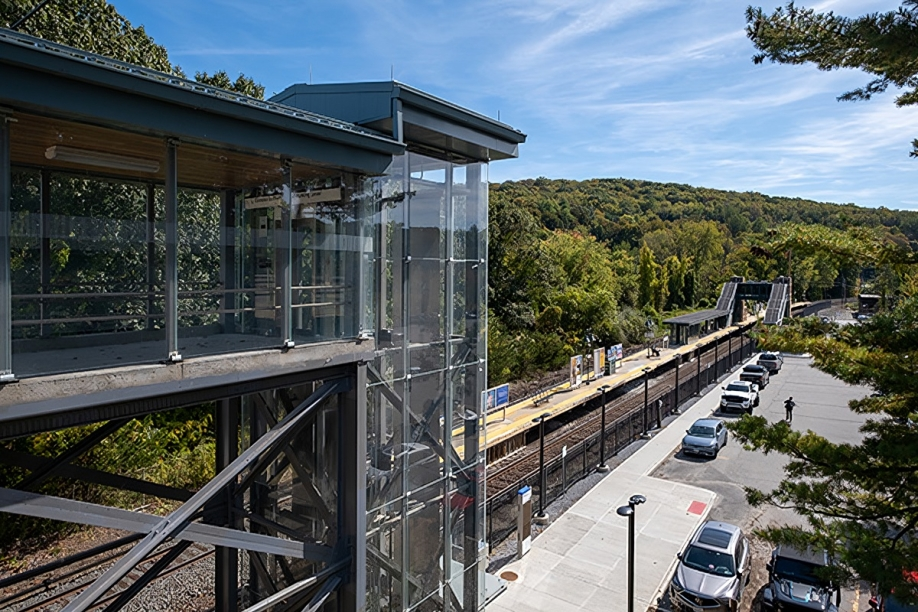
Bendheim provided design-assist services and its Wall F-20 Glass System to hold nearly 1,800 square feet of glass at Purdy Station, a historic commuter stop in New York’s Hudson Valley. Originally built in the mid-19th century, the station serves generations of commuters traveling to New York City.
Recent upgrades, led by the Metropolitan Transportation Authority (MTA), focused on system-wide accessibility, adding elevators and ADA-compliant walkways connecting parking areas, the Route 116 overpass, and the station entrance.
“Safety is of paramount concern for Metro-North, and achieving the least obstructive views is mandatory when designing a station,” said Technical Principal at AECOM, Neils Benavides.
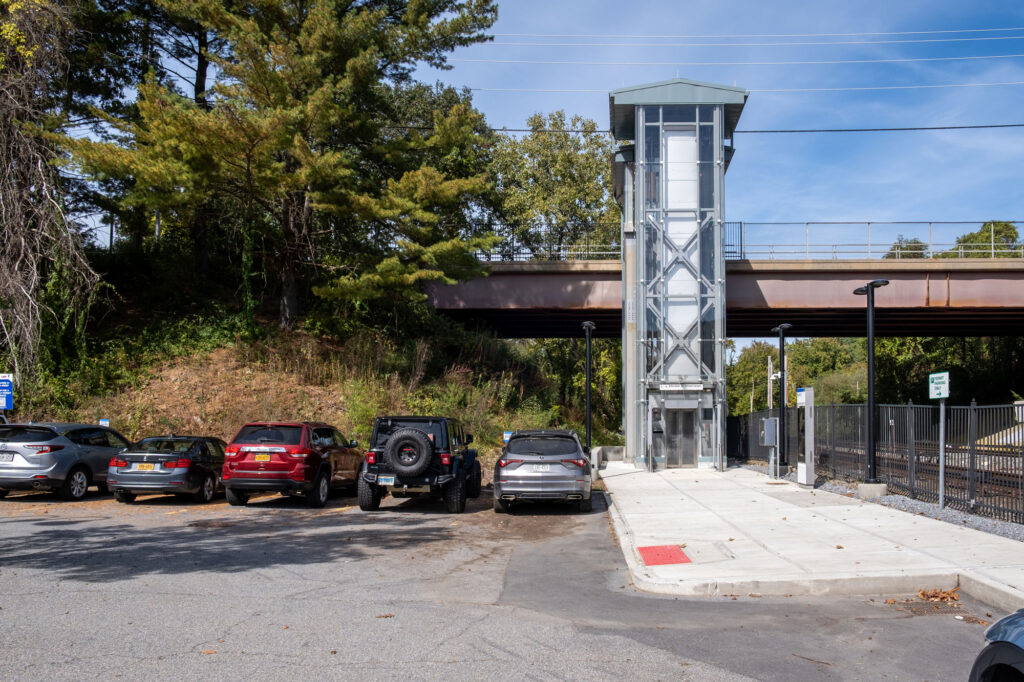
The Wall F-20 Glass System was selected for its practicality, cost-effectiveness, and ease of installation, while maintaining aesthetic value. The site’s sloped topography and proximity to roadways required a barrier that ensured pedestrian safety without overwhelming the rural surroundings. Bendheim’s system provided a minimally intrusive enclosure, preserving clear sightlines, natural light, and views of nearby farmland and forested terrain. 
Benavides praised Bendheim’s coordination during the shop drawing phase, noting, “Their multi-dimensional drawings helped resolve potential clashes, avoiding delays and rework.”
Bendheim highlights Purdy Station as an example of how a well-engineered rainscreen system can reliably balance safety, performance, and aesthetics. By leveraging a standardized solution supported by design assistance, project teams achieve consistent results while controlling costs.
Source: Bendheim with additional information added by Glass Balkan