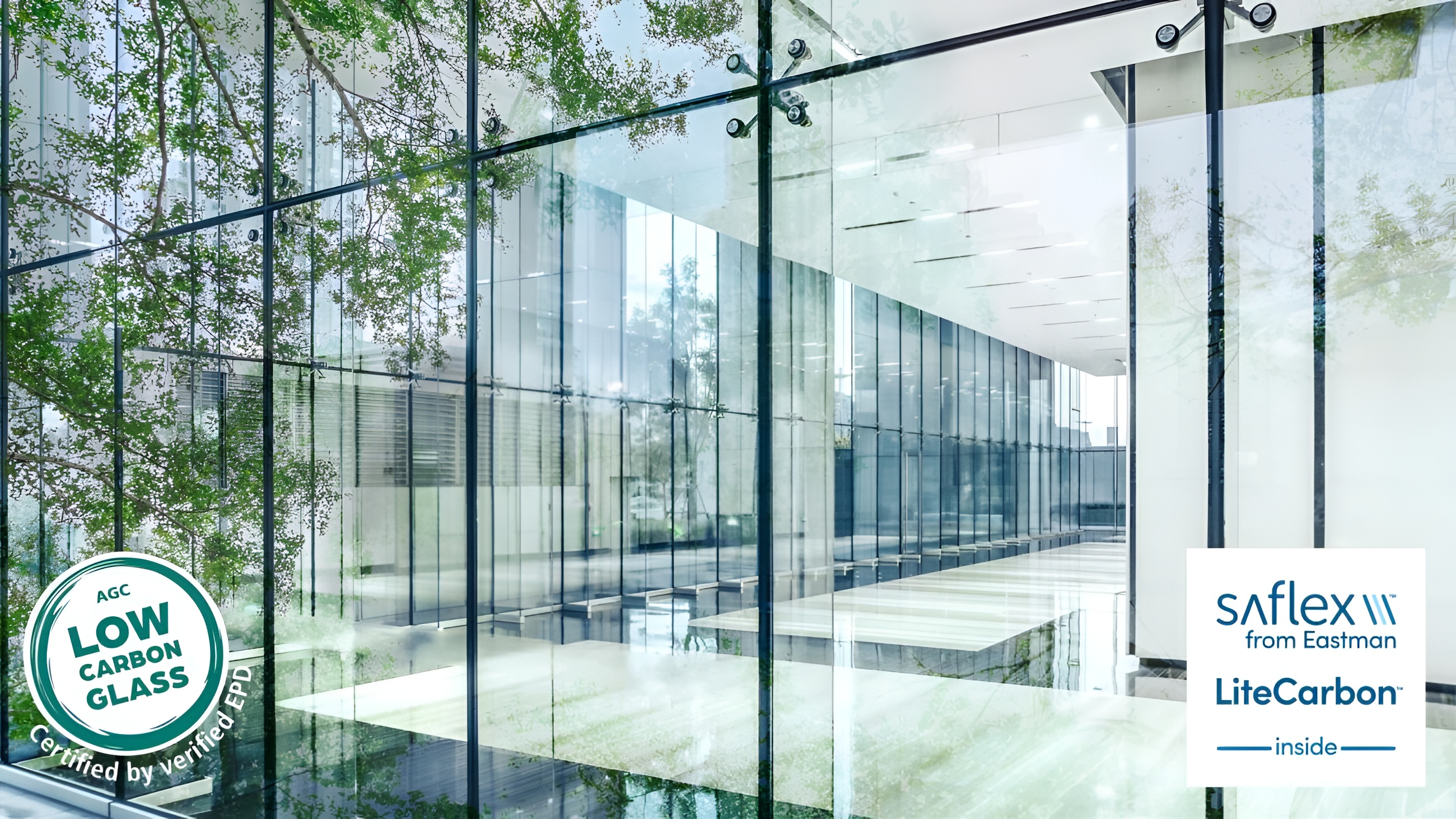
AGC Glass Europe has introduced a significant advancement in sustainable glazing by combining its proprietary low-carbon float glass with Eastman’s Saflex™ LiteCarbon™ Clear polyvinyl butyral (PVB) interlayers. The collaboration has resulted in some of the industry’s lowest embodied carbon values for laminated architectural glass while maintaining the performance standards required for modern façade and building applications.
The new Low-Carbon Stratobel range delivers exceptionally low Global Warming Potential (GWP) values measured on a cradle-to-gate basis (A1–A3) in accordance with EN 15804+A2:2019. Low-Carbon Stratobel 33.1 achieves a GWP of just 9.1 kg CO₂ equivalent per square metre, while Low-Carbon Stratobel 44.2 records 12.9 kg CO₂ equivalent per square metre. These figures are verified through AGC’s third-party certified Environmental Product Declaration (EPD) Generator, providing independently validated environmental data for project teams.
Beyond reducing embodied carbon, the products also demonstrate a high level of material circularity. Both Low-Carbon Stratobel 33.1 and 44.2 contain 62% recycled content, calculated according to ISO 14021 and the Glass for Europe methodology. The recycled content combines recycled glass within the substrate and recycled material incorporated into Eastman’s Saflex™ LiteCarbon™ Clear PVB interlayer, creating one of the most circular laminated glass solutions currently available for the construction sector.
AGC has also made lower-carbon PVB the standard specification across the entire Low-Carbon Stratobel Clearlite range. Available in all clear glass and PVB thickness combinations, the solution eliminates the need for customers to request a special sustainable option, allowing architects, façade consultants, glass processors and installers to specify lower-carbon laminated glass without additional lead times or design changes. 
To support sustainable building projects, AGC provides complete environmental transparency through project-specific EPDs generated via its verified EPD Generator. Consolidated data covering Global Warming Potential and recycled content is also available on invoices or through comprehensive reports upon request.
Source: AGC with additional information added by Glass Balkan