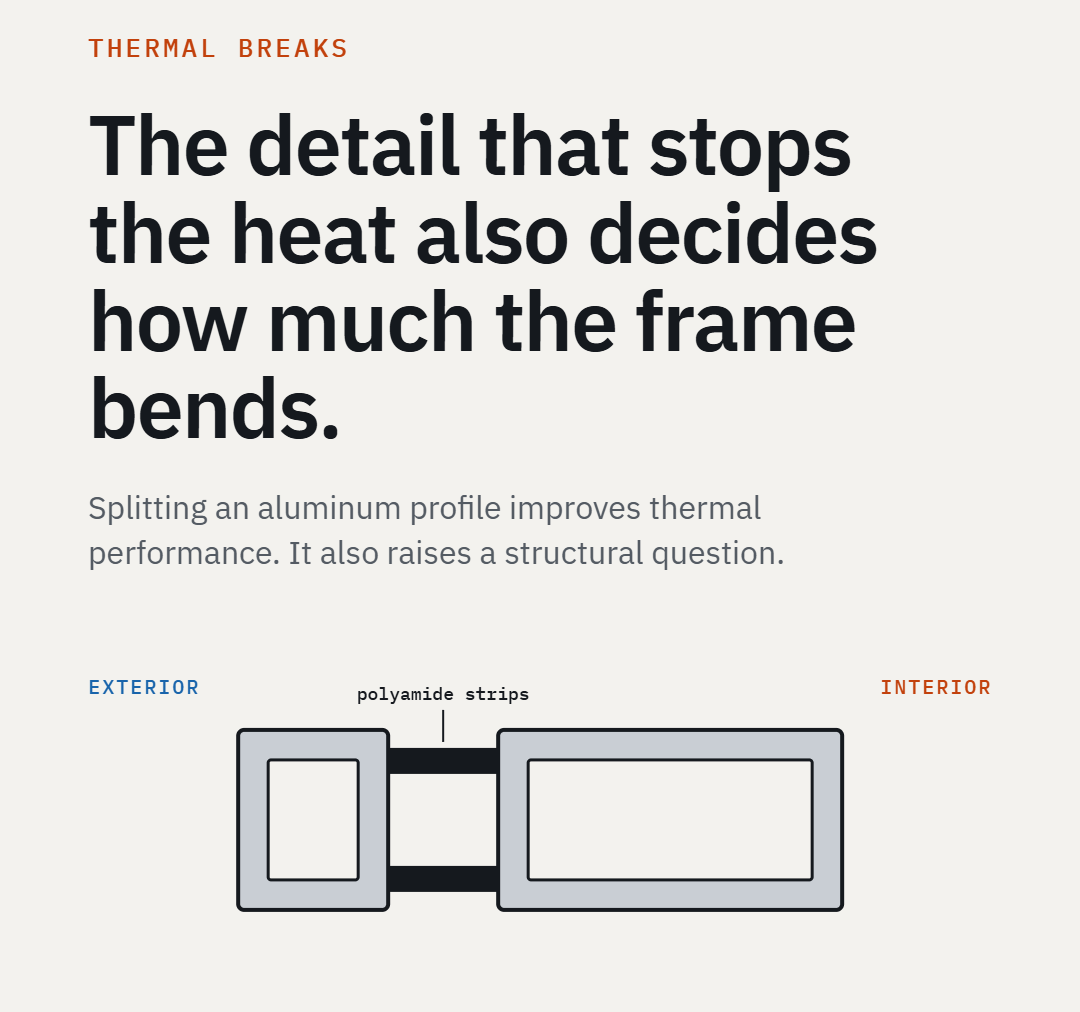
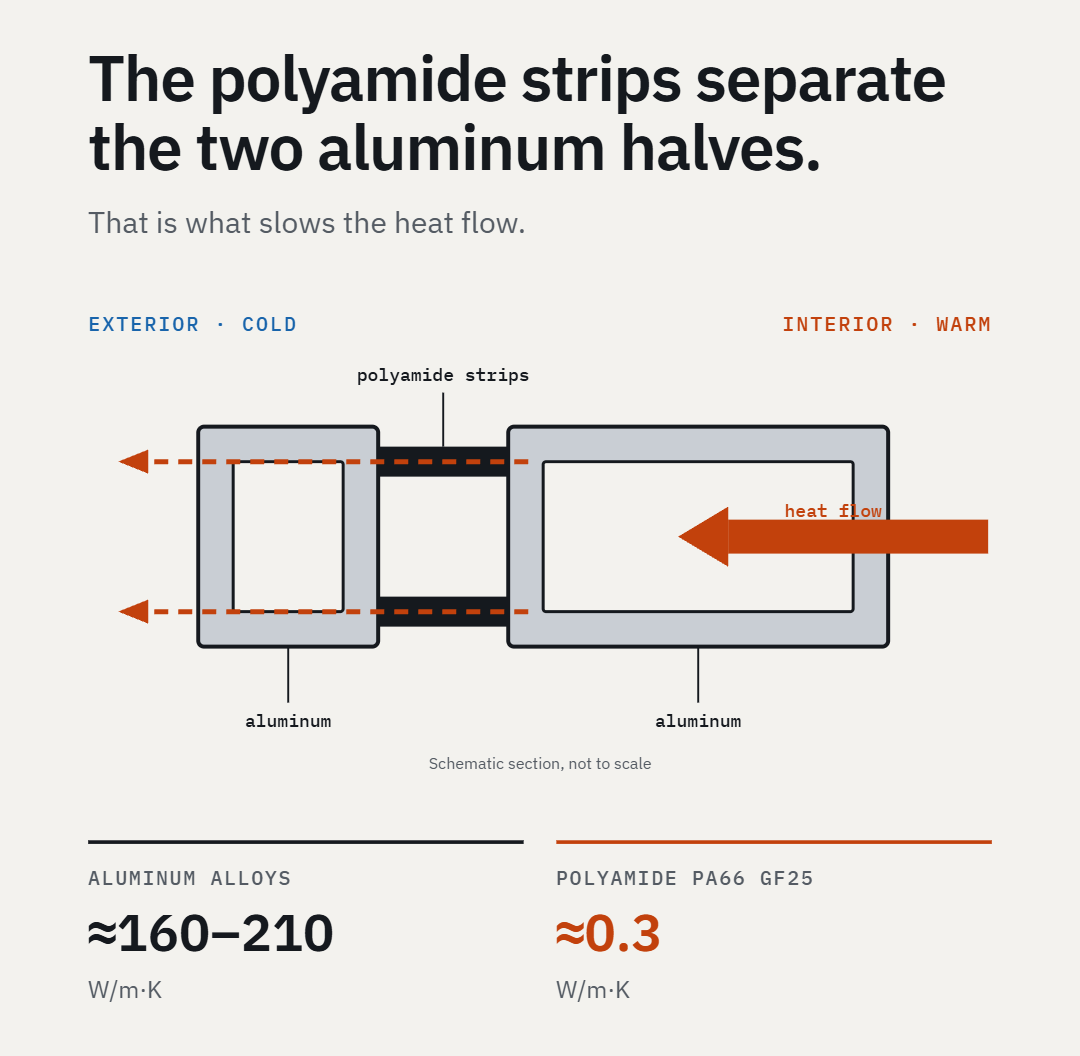
Thermally broken aluminium framing is standard in modern façades. The reason is simple: aluminium conducts heat very well, at roughly 160–210 W/m·K. Polyamide strips, typically PA66 reinforced with 25% glass fibre, conduct at about 0.3 W/m·K.
Placed between the interior and exterior halves of an aluminium profile, these strips significantly reduce heat transfer through the frame.
But separating the profile changes more than its thermal performance. It also affects how the frame carries structural loads.
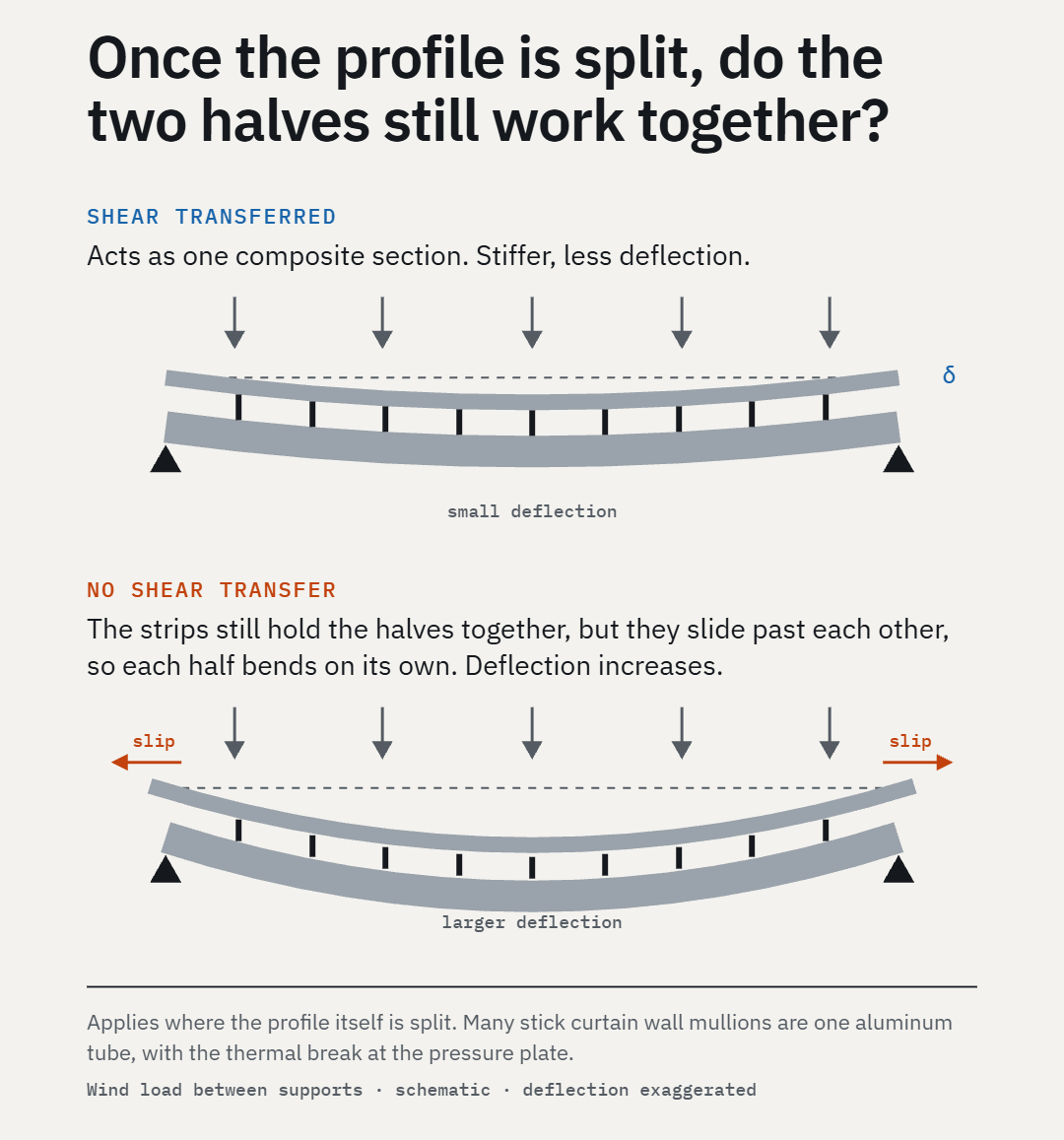
Do the two halves still work together?
A mullion resists wind loads by bending. If the thermal break transfers shear between the two aluminium halves, the profile acts as one composite section. This increases its stiffness and helps limit deflection. 
If the thermal break does not transfer sufficient shear, the halves can slide relative to each other and bend more independently. Although the strips still connect them, the profile loses much of its combined stiffness, resulting in greater deflection.
This is why EN 14024 classifies thermal barrier systems according to their mechanical performance and shear-transfer capacity.
Temperature changes the equation
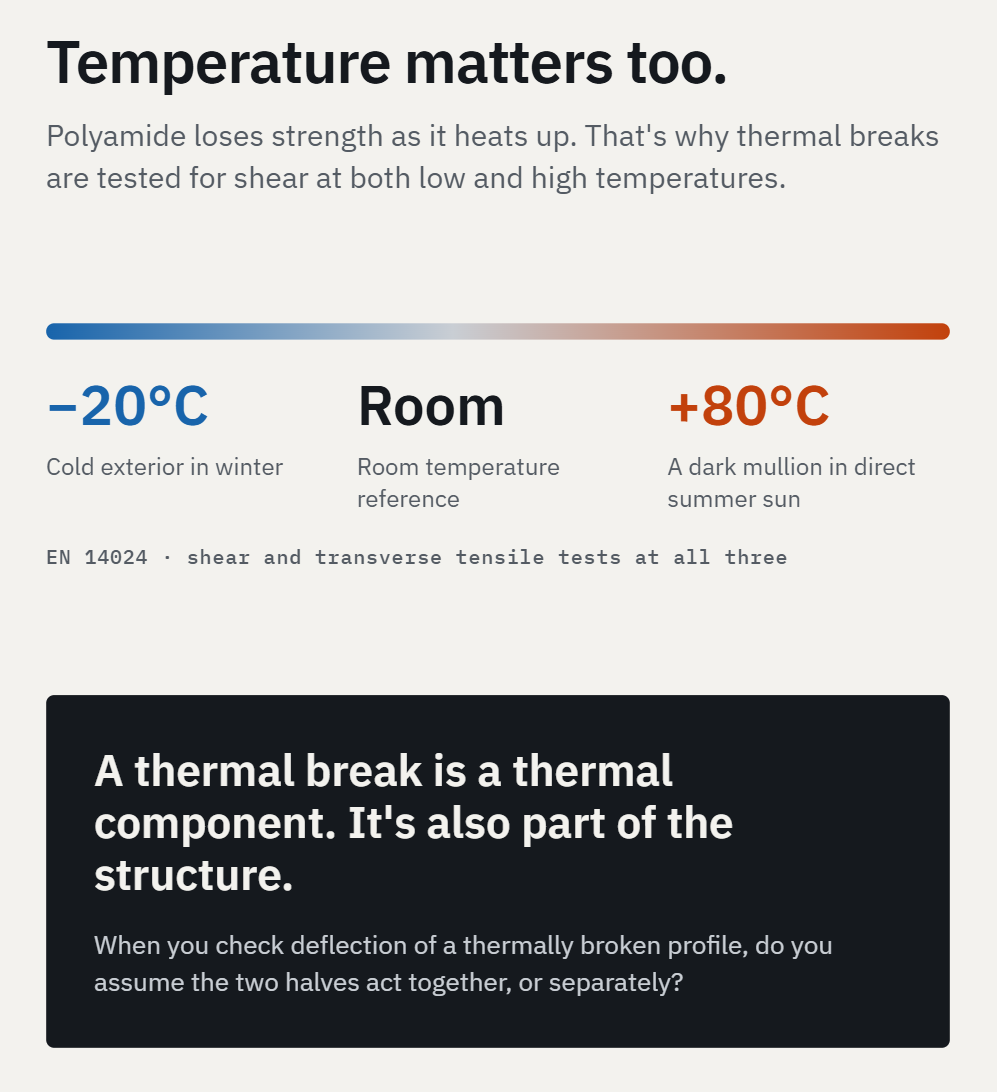
Polyamide loses strength as its temperature increases. A dark-coloured mullion exposed to direct summer sunlight can approach temperatures of +80°C, while in winter, the exterior section may fall well below freezing.
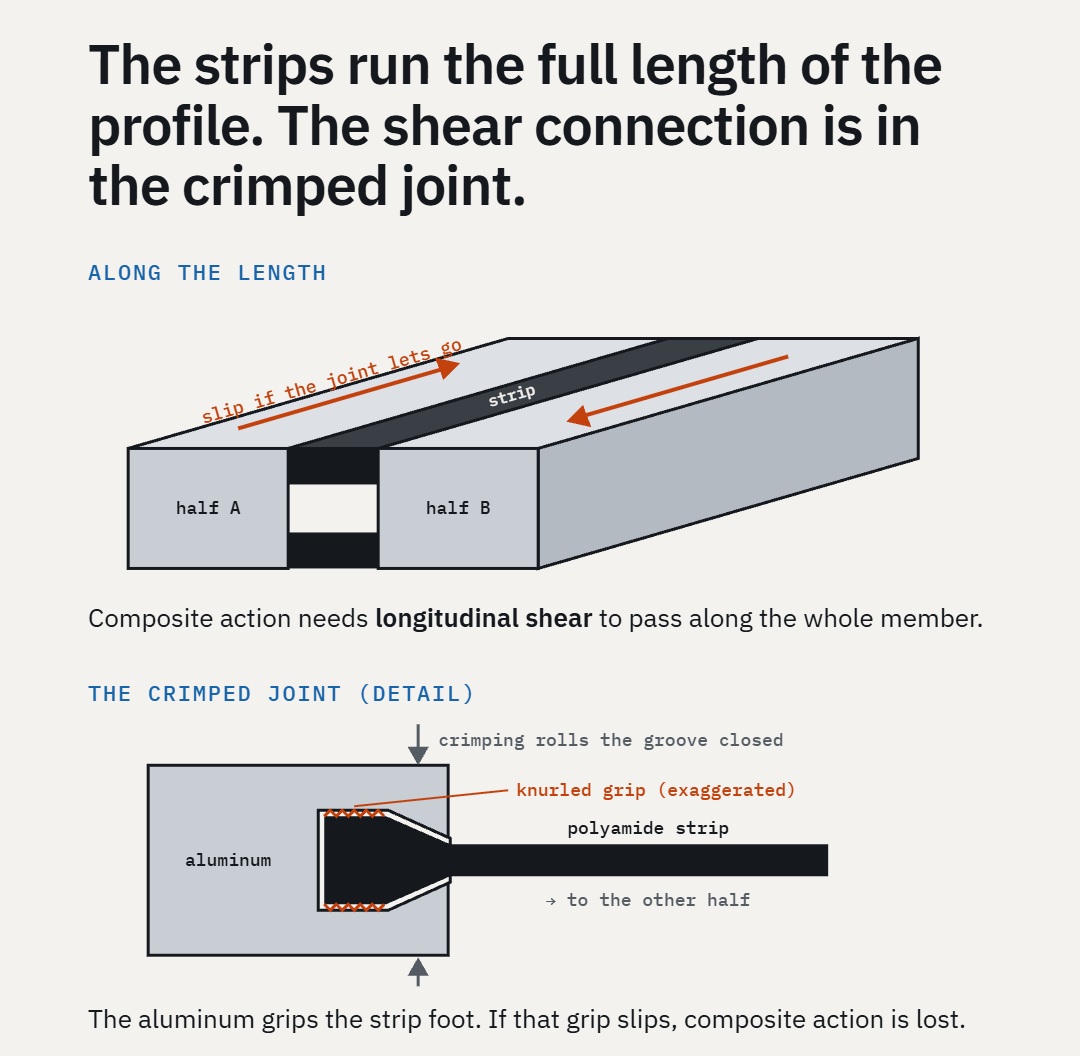
For this reason, thermal break connections are tested for shear and transverse tensile strength at low, room and elevated temperatures. A connection that performs adequately at room temperature may behave differently under the thermal conditions experienced by an exposed façade.
What does this mean for façade design?
When calculating mullion deflection, the assumption about composite action must reflect the actual shear-transfer capacity of the thermal break across the relevant temperature range and throughout the building’s service life.
A thermal break is not only a thermal component. It is also part of the structural system.
When calculating mullion deflection, do you assume the two aluminium halves act together or independently?